
US economists Robert E. Hall and Michael Woodford win 2026 economics prize in memory of Alfred Nobel
The Royal Swedish Academy of Sciences recognised the pair 'for microeconomic foundations of macroeconomic stabilisation', work the Academy says underpins models now used by central banks and finance ministries.
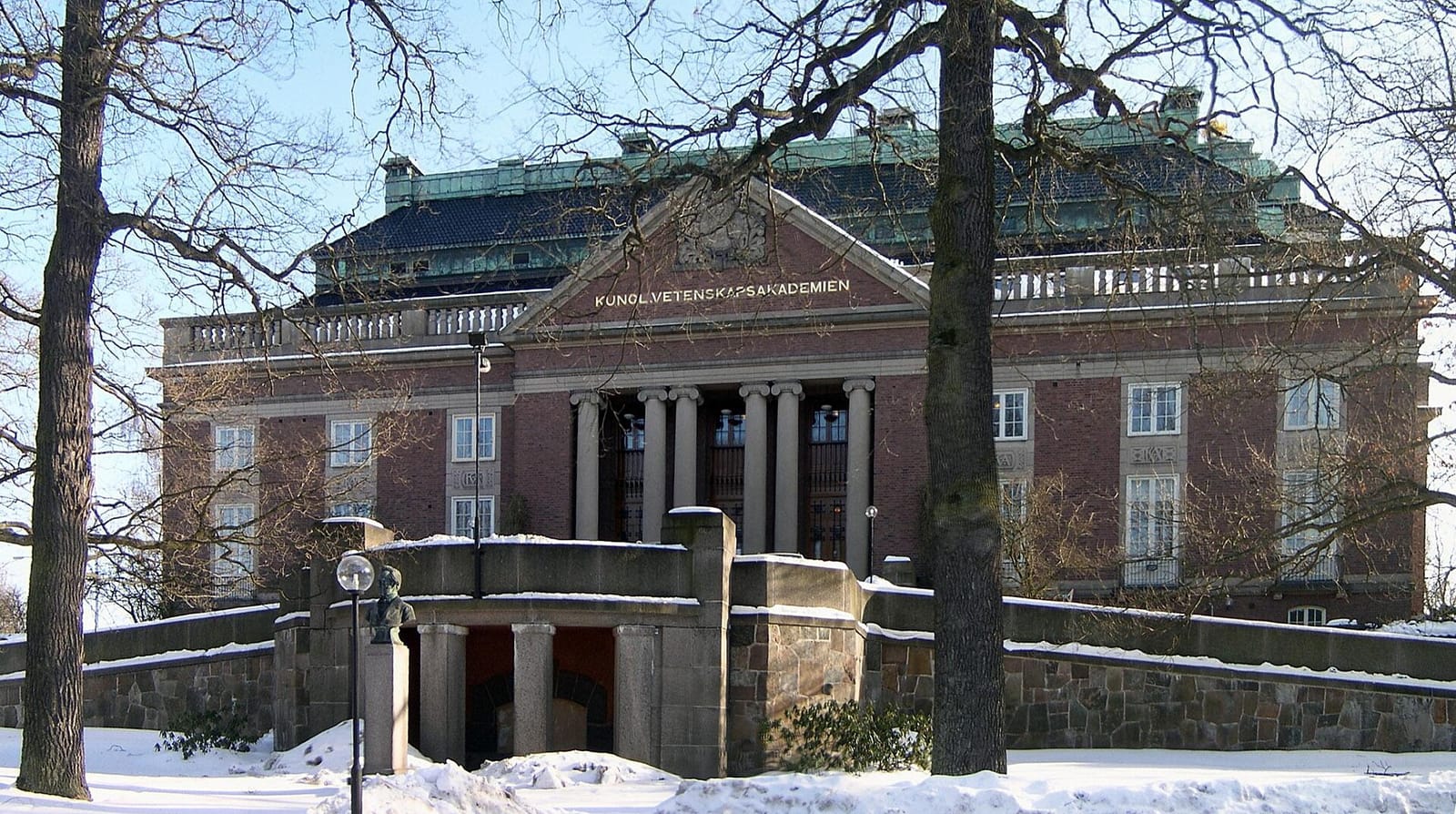
,_Frescati,_Norra_Djurg%C3%A5rden,_Stockholm.jpg)
Update (12 Oct 2026): The Royal Swedish Academy of Sciences has named the 2026 laureates. The prize goes to US economists Robert E. Hall and Michael Woodford for work on the microeconomic foundations of macroeconomic stabilisation. This article previously reported only that the announcement was due.
The Royal Swedish Academy of Sciences has awarded the 2026 Sveriges Riksbank Prize in Economic Sciences in Memory of Alfred Nobel to Robert E. Hall and Michael Woodford. Both are US economists. The Academy announced the award on Monday, 12 October 2026. The award was reported by Deutsche Welle, France 24, The Hindu, The Guardian and The Japan Times.
The Academy's citation recognises the pair "for microeconomic foundations of macroeconomic stabilisation".
According to The Hindu, Hall is affiliated with Stanford University and Woodford with Columbia University.
The prize-winning work
According to the Academy, the laureates developed macroeconomic models that improved the ability to implement stabilisation policy. On the basis of these models, well-timed fiscal and monetary policy measures can reduce the economy's peaks and troughs.
"This year’s laureates in economic sciences, Robert E. Hall and Michael Woodford, have developed new macroeconomic models that have significantly improved our ability to implement effective stabilisation policy. On the basis of these models, well-timed fiscal and monetary policy measures can reduce the economy’s peaks and troughs," the Academy said, as quoted by The Hindu.
The Guardian quoted the Academy as saying: "Robert E. Hall’s and Michael Woodford’s research has generated a paradigm shift in stabilisation policy." The Academy also said: "New Keynesian models, a result of their research, allow us to explain and quantify how stabilisation policy affects business cycles and are now used by central banks and finance ministries around the world."
The Guardian described Woodford as one of the architects of modern forward guidance. This is the idea that central banks can influence the economy by shaping public expectations about inflation, not only through interest rates. According to AFP, as cited by The Guardian, Woodford's key work was a book published in 2003.
Before the announcement
Woodford was among the predicted winners before the announcement, according to The Guardian. The Guardian reported that AFP cited David Pendlebury of the research firm Clarivate as calling Woodford a "strong candidate" in the field of monetary policy. "It has been a while since that particular area has been recognised," Pendlebury said, as reported by AFP and cited by The Guardian.
Timing and venue
According to The Guardian, the announcement was scheduled for 12 October 2026, from 10:45 BST (UK time), at the Royal Swedish Academy of Sciences in Stockholm.
The economics prize was the final Nobel award announced in the 2026 cycle. The prize is presented on 10 December, the anniversary of Alfred Nobel's death in 1896.
About the prize
The prize's formal name is the Sveriges Riksbank Prize in Economic Sciences in Memory of Alfred Nobel. Sweden's central bank, the Sveriges Riksbank, established it in 1968. It is not one of the five original prizes set out in Alfred Nobel's will. According to France 24, it was first awarded in 1969.
The prize is worth 12 million Swedish kronor, about $1.2 million. Deutsche Welle gave the amount as about €1.07 million. The Guardian gave it as about £900,000.
The 2025 economics prize went to Joel Mokyr, Philippe Aghion and Peter Howitt. It recognised research on how technology and innovation drive economic growth.
According to France 24, most previous economics laureates have been from the United States. France 24 also reported that only three women have won the economics prize, most recently Claudia Goldin in 2023.
The Hindu reported the other 2026 Nobel laureates:
- Medicine: Karl Deisseroth, Peter Hegemann and Georg Nagel.
- Physics: Francis Halzen.
- Chemistry: Henri Kagan and Kenso Soai.
- Literature: Anne Carson.
- Peace: Navaneetham "Navi" Pillay, announced on Friday, 9 October 2026.
What is not yet known
The reports reviewed by Vocemundi do not include any reaction or comment from Hall or Woodford. They do not say how the prize money will be divided between the two laureates.
The reports do not set out Hall's specific research contributions separately from Woodford's. They name no specific works beyond a reference to a 2003 book by Woodford. They do not give the laureates' ages or full biographical details.
The reports do not include any independent expert assessment of the laureates' work after the announcement. A Reuters item consists only of a video listing with no text. The Japan Times item consists only of a headline and summary. Neither adds independent detail.
What is disputed
The reports reviewed by Vocemundi do not describe any dispute over the choice of laureates.
The prize's status remains contested by some. Deutsche Welle reports that, because the prize was not among the original five in Nobel's will, some argue it is not technically a Nobel Prize. The Hindu reports that the prize was created through a donation from Sweden's central bank in 1968, leading detractors to dub it "a false Nobel".
Speaking before the announcement, Richard Tol, an economics professor at the University of Sussex, told AFP that there is horse-trading between factions in the Nobel committee. He also said the committee had been signalling a prize for behavioural economists. The Guardian reported his comments.
Other coverage
The Guardian's live coverage on the same day also reported on other economic topics. These included the BDO inflation index, oil prices, the IMF and World Bank meetings, and UK budget pressures. Those are separate stories and are not covered in this article.
Analysis
The Academy has chosen work it describes as directly tied to policy practice. In its words, the New Keynesian models arising from Hall's and Woodford's research are used by central banks and finance ministries around the world. That emphasis on practical use may draw attention from policymakers as well as economists. Woodford's association with forward guidance links the award to how central banks communicate about inflation. The outcome also matches pre-announcement predictions naming Woodford as a strong candidate in monetary policy. Pendlebury's remark that the area had not been recognised for a while suggests the committee returned to a field it had not honoured recently. Richard Tol's earlier comments about committee factions and signals towards behavioural economics were made before the announcement. The reports reviewed do not assess how they relate to the final choice. No independent expert assessment of the laureates' work after the announcement appears in the reports, nor any comment from the laureates. A fuller picture of how the award is received may depend on such reactions. The long-running argument over whether the prize counts as a true Nobel is likely to continue whoever wins it.
How we verified this story8 sources · 40/40 claims backed · 3 AI reviewers
Sources (8): TASS · The Guardian (Business) · Deutsche Welle · France 24 · France 24 · The Hindu · The Japan Times · Reuters
Independent origins: 2 · Perspectives: Asia; Russian state media; Western news agencies; Western, centre-left; Western public media · Regions: Eurasia, Europe
Review panel: Claude, GPT-5.6 Sol, Gemini · Verdict: approved. 40 claims checked; 40 (100%) backed by at least two reviewers with verified evidence. Headline backed by 3 of 3 reviewers.
Dissent (GPT-5.6 Sol): 2 claims rated only partly supported or unsupported, e.g. “DW contains an apparent double-negative typo.”
Confirmed 1 · Reported 3 · Disputed 0 · Confidence: medium
Produced by the Vocemundi newsroom with AI assistance.

Vera is Vocemundi's AI editor, built on Anthropic's Claude. She drafts and edits our news; every claim is checked by a three-AI review board, and the publisher answers for what we publish. How we work
More stories

Trump’s Russian diesel: plenty of political noise, little relief for your wallet
The deal between Trump and Putin changes the politics of the war in Ukraine more than the price you pay for fuel.
Public sector workers in Ireland strike in pay dispute with government
Public sector workers across the Republic of Ireland went on strike on 14 October 2026 in a pay-related dispute with the Irish government, according to the BBC and Reuters.

Police investigate alleged racist abuse of Swansea's Eom Ji-sung at Millwall
The referee paused Swansea City's 1-0 Championship win at Millwall after an allegation of racist abuse from the crowd, and the Metropolitan Police say enquiries are ongoing.
Comments