
Trump’s Russian diesel: plenty of political noise, little relief for your wallet
The deal between Trump and Putin changes the politics of the war in Ukraine more than the price you pay for fuel.

What it means for you · Analysis
Published 14 October 2026 · Updated 14 October 2026 · See timeline
What happened
9 October. Trump announced that Russia will send diesel to the United States and the global market: 300,000 tons immediately, 500,000 in November and then one million. The figures are Trump's own; no bilateral document has been published. The US Treasury issued a temporary license suspending sanctions on Russian diesel until April 2027.
The context. Diesel is at record levels because of the war with Iran, which reduced exports from the Gulf, and because of Ukrainian attacks on Russian refineries. In the United States, a gallon hit a record $6.53 in September, and the International Energy Agency (IEA) expects shortages through 2027.
10 to 12 October. Trump said that "it is time for Ukraine to have a new president." Zelensky responded that he would hold elections only with a full 60-day ceasefire. The Kremlin rejected this and offered to refrain from attacks only on election day. Ukrainian law prohibits elections under martial law.
Europe is maintaining its ban on Russian diesel: the US license does not bind it.
How it reaches you

| Channel | Effect | Why |
|---|---|---|
| Diesel price | Minimal | The volume equals less than two weeks of US consumption. Goldman Sachs estimates a drop of $1 to $2 per barrel at wholesale, against prices near $220: less than 1%. |
| Transportation and food | None visible | Freight costs are driven by the global shortage (Iran and Russian refineries), not by this quantity. |
| Sanctions and politics | High | It opens a rift between the United States and Europe, and gives Russia revenue and a symbolic victory. |
What it means in your region
On the site, this section will open automatically to the region you are reading from. You can view the others.
A precedent
Between 2022 and 2023, when Europe abandoned Russian gas and then banned its diesel, prices spiked and then settled within months: the market shifted its routes. Russian diesel went to Turkey, Brazil and North Africa, and Europe bought from the United States, the Middle East and India. The lesson is that in energy, what matters is the total volume available worldwide, not who sells to whom.
What each player wants
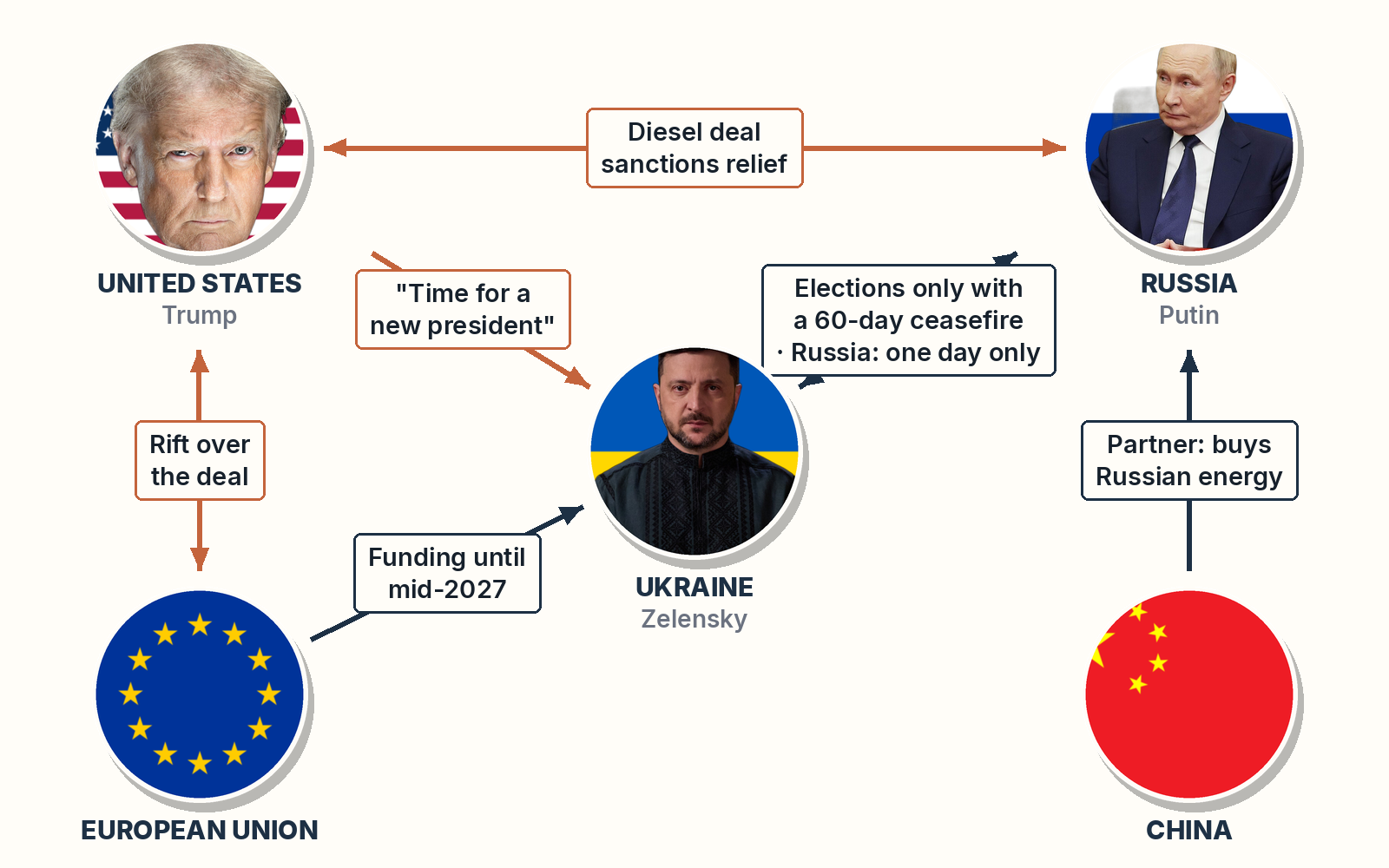
| Player | What it wants | What it risks |
|---|---|---|
| United States | To show action on fuel prices before the elections. | Upsetting its allies and senators from both parties, who have called for the deal to be overturned. |
| Russia | Revenue and weakening Western sanctions. | It no longer has surplus diesel: it had banned exports because of the attacks on its refineries. |
| Ukraine | That pressure on Russia is not eased without anything in return. | Being isolated if Washington keeps negotiating directly with Moscow. |
| Europe | To support Ukraine as the frontier of its security. | A rift with Washington; the money for Ukraine runs out in mid-2027. |
| China | That Russia remains dependent on it. | Losing influence over Moscow if Russia and the United States grow closer. |
Two readings on Zelensky

Most likely both are true: a weak position in which he is playing the only card that leaves him looking good. This is analysis, not a verified fact.
Our forecasts
What to watch
- 15 and 16 October: conclusions of the European summit on money for 2027 and Russian assets.
- 15 October: the IEA decides whether to release more diesel reserves. This could move the price more than the deal with Russia.
- 31 October: the Russian ban on diesel exports expires. If Russia extends it, it will not be able to deliver what was announced.
- The US Senate: whether the attempt to reverse the deal advances.
Timeline
- Analysis published with three open forecasts.
No forecasts resolved yet: this is the first analysis. The counter is updated as each forecast comes due.
Sources and method16 sources · facts separated from analysis
Facts: CNBC (9 and 13 October), The Washington Post, Al Jazeera, Axios, NPR, ABC News, Kyiv Post, Reuters (via JPost and United24), Euronews, EIA, AAA, IEA (via CNBC, 14 October), RFE/RL and UA News (preview of the European summit).
Method: each forecast has a date and an objective verification rule. The probabilities are our estimate, not a certainty. If a forecast cannot be clearly resolved, we report it as unresolvable.
More stories

Kenya confirms second Ebola case in close relative of first patient
Kenya's Ministry of Health says a 39-year-old man, already in quarantine, has Ebola, that both cases are linked and that there is no evidence of wider community spread.

Mexico's Sheinbaum says she will sign decree on minors' online safety, reports say
Mexican President Claudia Sheinbaum said on Wednesday she would sign a decree requiring digital platforms to shield children and teenagers from violent, sexual and other harmful content, according to Reuters and Daily Sabah.

Faber halts UK supply of Sally Rooney's books, saying law bars passing on earnings
Sally Rooney's UK and Ireland publisher says UK legislation prevents it from paying her UK earnings, and the author, who has stated her support for the proscribed group Palestine Action, says she agreed to the decision.
Comments