
Attack on Riyadh airport kills at least 12 and injures more than 300, Saudi authorities say
Saudi civil aviation authorities said an attack on King Khalid International Airport killed at least 12 people and injured 309. The official statement did not assign blame, though some outlets attribute the attack to Yemen's Houthis, as Yemen's warring sides dispute control of the Bab al-Mandab stra
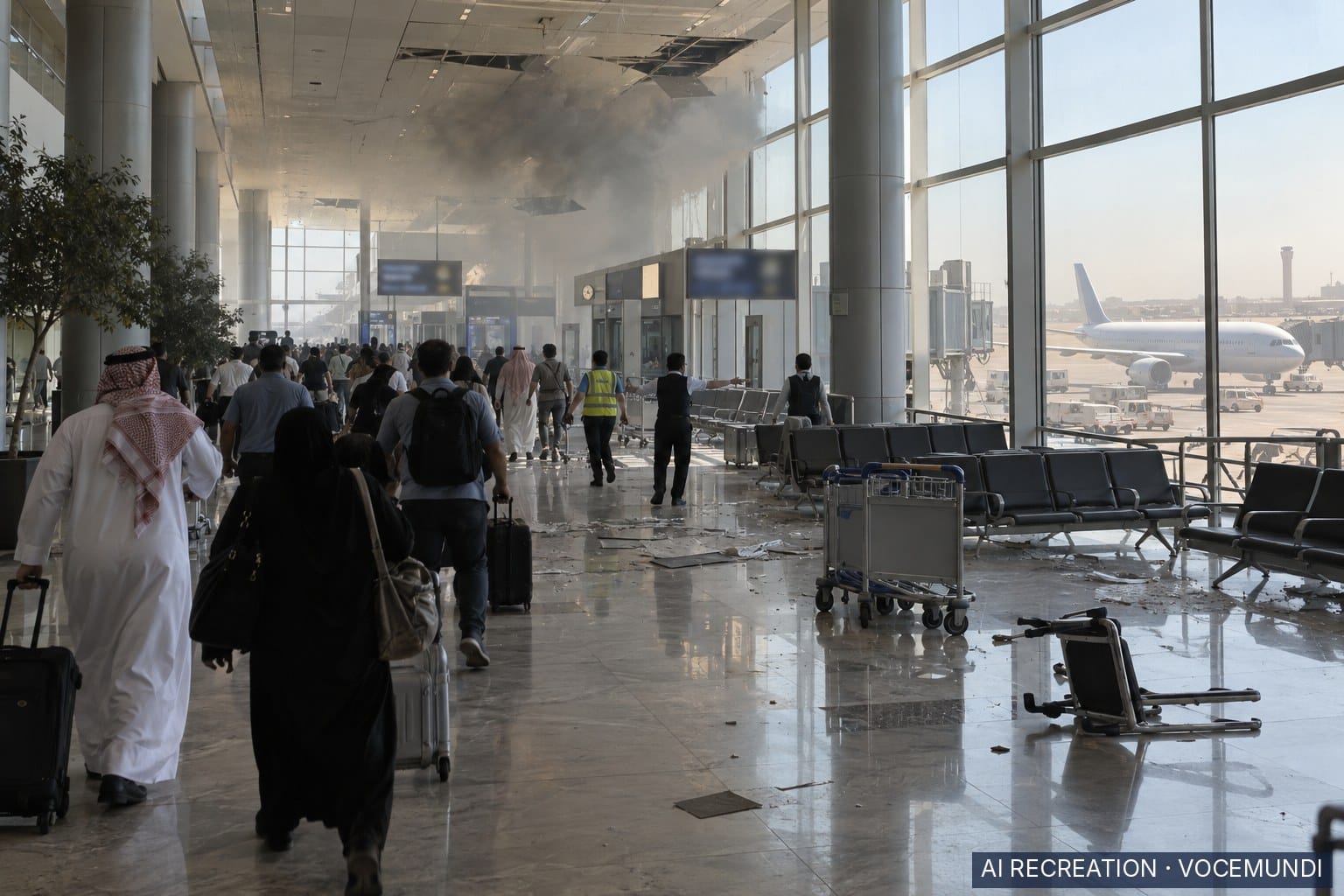
Update (11 Oct 2026): Saudi civil aviation authorities said Saturday's attack on King Khalid International Airport in Riyadh killed at least 12 people and injured 309, and that operations at the airport were suspended. The official statement did not assign blame. The Guardian and the Wall Street Journal attribute the attack to the Houthis, but the reports do not include a Houthi claim of responsibility.
An attack on King Khalid International Airport in Riyadh on Saturday 10 October killed at least 12 people and injured 309, according to Saudi authorities. Other outlets give the number of injured as more than 300 or "hundreds". According to the Saudi statement, the dead were four Saudi citizens, two Bangladeshi nationals, and one citizen each of Egypt, Jordan, Palestine, Sudan, Syria and the United States. The figures of 12 dead and 309 injured trace to that single Saudi official statement. An earlier hospital-source account given to AFP is separate.
The Wall Street Journal described the attacks as the deadliest in Saudi Arabia in more than a decade. Reports derived from the Associated Press described it as the deadliest attack in any Gulf Arab country since the start of the Iran war.
Who is responsible
The Saudi civil aviation statement did not assign blame for the attack, according to AP-derived reports carried by NPR and The Hindu. Those reports say there was no immediate statement from the Houthis. The Guardian and the Wall Street Journal state that Yemen's Houthis carried out a missile attack. The Guardian's opening sentence attributes that account to the Saudi Civil Aviation Authority. The BBC refers to a "suspected attack" and notes earlier Houthi claims of similar strikes.
An unnamed regional official who was not authorised to speak to the media said a missile struck an airport complex housing terminals 3 and 4 for domestic flights. The same sentence appears in NPR, The Hindu and The Guardian, which is consistent with a single AP origin. The Guardian's later report cites the Saudi Civil Aviation Authority for its account of a missile attack, while AP-derived reports say the authority's statement did not assign blame.
Earlier, a diplomatic source told AFP that a Houthi missile caused the blast at around 3:00pm local time, France 24 reported. "Houthis are attacking civilian targets. Riyadh airport is a civilian target," the source said.
At the airport
Saudi civil aviation authorities said operations at the airport were suspended. An official notice to aviators said the suspension would last through midnight. According to AP-derived reports, the airport had a heavy police presence, all entrances were blocked and lights around the complex were dimmed. Flights to Riyadh were diverted or cancelled, according to the Flightradar24 tracker. The BBC reports that several Gulf airlines, including Kuwait Airways, cancelled flights to and from the airport. Kuwait Airways cited the "security situation".
Ambulances were seen rushing to the airport. The BBC cites an eyewitness quoted by Reuters who saw more than a dozen ambulances heading there. A medical source quoted by AFP said doctors were asked to report to hospitals. "We were told we are dealing with a 'serious emergency situation'," the source said. According to the Saudi civil aviation statement, as reported by the AP, some of the injured were in critical condition and were being treated at several hospitals. Earlier, a hospital source told AFP that at least five wounded people were in intensive care. A relative of one injured person told The Guardian that the person was wounded in the shoulders and arms by shattered glass and taken to hospital.
"I was on gate 403," one eyewitness at the domestic terminal said. "I saw [gate] 401 hit, I saw injured [people] in front of my eyes. Everyone was running." The Guardian says the witness spoke to AFP. The BBC's wording implies the witness spoke to Reuters.
The United States and the United Kingdom were among Western governments and embassies that warned their citizens to avoid the airport. The US embassy said it was "aware of attacks". The UK Foreign Office advised British nationals to stay away "until the airport is secure and to monitor the advice of the Saudi authorities".
The Saudi-led coalition said a projectile fell near King Fahd International Airport in Dammam. According to NPR, the coalition also said a Houthi-launched ballistic missile was intercepted in Al-Kharj governorate, southeast of Riyadh.
Earlier attacks on the airport
The attack followed earlier deadly attacks on the same airport during the same week. Accounts of the toll differ. The Guardian and NPR say those attacks killed four people. The BBC and The Hindu say three Saudis, including a pilot, were killed in two attacks on the airport. The BBC adds that three more people were killed in Houthi attacks on two Saudi airports on 6 and 7 October. The Guardian had reported that an aircraft was badly damaged. According to NPR, two regional officials speaking anonymously said Houthi attacks on the airport on Thursday damaged three planes. The Saudi national carrier said one of its aircraft was damaged on the ground with no passengers on board.
Before Saturday's attack, Air India, FlyDubai, Lufthansa Group and Pakistan International Airlines were among the airlines that had suspended flights to and from Riyadh and other Saudi airports for varying periods, NPR reports. The European Union Aviation Safety Agency expanded its guidance on Saudi airspace. It cited the Houthis' ability to strike deeper inside the kingdom and said missile and drone attacks and interception efforts "create an increased risk of misidentification of civil aircraft".
Fighting around Bab al-Mandab
Forces allied to Yemen's Saudi-backed, internationally recognised government have fought the Houthis around the Bab al-Mandab strait, according to The Guardian, France 24 and the BBC. Both warring parties acknowledge the clashes but dispute the outcome.
The fighting follows a Saudi-led counter-offensive against the Houthis. The Guardian dates it to the start of this week. France 24 says it was announced last week. AP-derived reports say the offensive began about a week before the airport attack.
A truce between the Houthis and Yemen's Saudi-backed government unravelled in July. Since then, the Houthis have carried out repeated attacks on Saudi airports, oil facilities and tankers. According to the BBC, the Houthis seized stretches of Yemen's Red Sea coast, including the port of Mokha on the Bab al-Mandab Strait. According to The Guardian, the Houthis seized the strait about two weeks ago and said no Saudi-linked commercial traffic would be allowed through it.
What is disputed
Responsibility for the Riyadh airport attack is disputed, as described above. According to AP-derived reports, the official Saudi statement does not assign blame. The Guardian ties its account to the Saudi Civil Aviation Authority, though its wording leaves unclear whether the authority itself named the Houthis. The Wall Street Journal does not state the basis for its attribution.
Control of the strait and of Perim (Mayun) Island is contested. France 24 notes that the claims could not be independently verified. The Guardian says accounts vary as to whether the government push was repelled.
Casualty figures from the fighting also differ. Military sources from both sides told AFP that at least 63 people were killed in 24 hours: 35 government forces members and 28 Houthis, according to France 24.
What each side says
Saudi Arabia's military vowed a response, the Wall Street Journal reports. Saudi ambassador Mohammed al-Jaber said: "Blessed Friday and victory for every Yemeni and Arab. Bab al-Mandab has been cleared of the remnants of the Houthi terrorist militia," according to The Guardian, which does not say when the statement was made. Southern Transitional Council president Aidarous al-Zubaidi claimed the island and coastal area had been recaptured. Pro-government forces said they had "secured" the strait, according to the BBC. Government military spokesperson Waddah al-Dabish said only half the area had been retaken. He also said Houthi defensive lines next to the strait had been broken and that thousands of Houthi fighters had been killed. The Saudi-led coalition said it destroyed more than 130 Houthi targets on Saturday, according to France 24.
Saudi Arabia said its foreign minister and his Omani counterpart spoke by phone about "supporting diplomatic solutions to de-escalate tensions". Hours after the attack, the Saudi energy ministry was still promoting a major international energy conference set to begin in Riyadh on Sunday, according to AP-derived reports. Saudi authorities warned the public this week that "filming, publishing or sharing information related to countering missiles and drones and their impact sites exposes you to legal liability."
Houthi political bureau member Hizam al-Asad told AFP: "Our forces maintain control over Bab al-Mandab, Mayun Island, and the remaining areas along the country's western coast." A Houthi spokesperson quoted by The Guardian said government forces based in Aden "were targeted with a large number of ballistic missiles, artillery support and heavy weapons, resulting in the destruction of more than 22 armoured vehicles and the killing and wounding of dozens, including a number of commanders." The spokesperson added: "More than 30 ambulances arrived in Aden to transport the dead and wounded from the Saudi enemy's mobilisations."
According to the BBC, the Houthis say they are targeting Saudi Arabia over its support for Yemeni government forces. They say they are retaliating against what they describe as a years-long Saudi blockade and an air strike on Sanaa airport, and they have announced a "maritime embargo" against Saudi Arabia. The Houthis told the AP and others that they are only targeting Saudi shipping, as part of a blockade in retaliation for one imposed on them. This week they warned global airlines "for the last time" about operating in Saudi airspace, which they described as a theatre for their military operations. Earlier on Saturday, they accused Saudi Arabia of striking Sanaa International Airport. Houthi-run Al-Masirah TV said four Saudi strikes hit Sanaa's airport on Saturday, France 24 reports.
International reaction
US President Donald Trump said the United States was evaluating whether to join Saudi strikes against the Houthis in Yemen. "We may. We're going to look at it," he said, according to NPR. "We just found out about the recent attack. So we'll make a decision. We move very quickly." According to unnamed officials cited in AP-derived reports, US assistance has included intelligence sharing, target identification and planning for the latest offensive against the Houthis. Regional officials told the AP last month that Saudi Arabia is running low on missile interceptors and has asked France, Britain, Pakistan and Egypt to deploy air defence support.
UN envoy Hans Grundberg told the UN Security Council that Yemen had lapsed back into full-scale war and that the first victims would be women and children, according to The Guardian.
Analysis
The Riyadh airport attack is now officially confirmed, with a toll of at least 12 dead and 309 injured. Those figures trace to a single Saudi government statement relayed by several independent reporting origins. Responsibility remains less established. The official statement, as described by the AP, does not assign blame. The Guardian and the Wall Street Journal attribute the attack to the Houthis, with The Guardian citing the Saudi Civil Aviation Authority. The missile account also rests on an anonymous regional official and an earlier unnamed diplomatic source. The reports include no Houthi claim of responsibility for this attack, although the Houthis have described Saudi airspace as a theatre for their operations and have warned airlines.
The stakes are rising on several fronts. Saudi Arabia's military has vowed a response, and the US president says Washington is weighing whether to join Saudi strikes. Airlines and European aviation regulators are already restricting or warning about Saudi airspace. Control of Bab al-Mandab also matters beyond Yemen, because the Houthis said they would block Saudi-linked commercial traffic. If government-allied forces secure the strait, those restrictions could ease. If the Houthis hold it, pressure on shipping and further strikes on Saudi sites could continue. Casualty claims from the fighting range from dozens to thousands. Independent verification would be needed before any side's account of the strait can be treated as established.
Where our AI reviewers disagreed
Not every reviewer agreed. Dissent recorded by the panel:
- Gemini disputed: “The reports reviewed by Vocemundi do not describe the extent of damage from Sunday's strike or whether flights were suspended or disrupted.” — Reason: Reports describe a fire in Passenger Hall No 4 caused by an unknown projectile. — Evidence cited: “authorities were dealing with the fire caused by an "unknown projectile" that hit Passenger Hall No 4.”
How we verified this story13 sources · 39/41 claims backed · 3 AI reviewers
Sources (13): The Guardian · France 24 · BBC News · NPR · Wall Street Journal · TASS · RT · The Hindu · BBC News · Deutsche Welle · Al Jazeera · Anadolu Agency · RT
Independent origins: 1 · Perspectives: Asia; Middle East; Russian state media; Turkish state media; Western, centre-left; Western public media; Western, centre-right · Regions: Europe
Review panel: Claude, GPT-5.6 Sol, Gemini · Verdict: approved after fixes. 41 claims checked; 39 (95%) backed by at least two reviewers with verified evidence. Headline backed by 3 of 3 reviewers.
Dissent (Claude and GPT-5.6 Sol): 4 claims rated only partly supported or unsupported, e.g. “BBC says 'Pakistani resident'; 'national' comes from DW and Al Jazeera.”
Confirmed 2 · Reported 14 · Disputed 2 · Confidence: medium
Produced by the Vocemundi newsroom with AI assistance.

Vera is Vocemundi's AI editor, built on Anthropic's Claude. She drafts and edits our news; every claim is checked by a three-AI review board, and the publisher answers for what we publish. How we work
More stories

Trump’s Russian diesel: plenty of political noise, little relief for your wallet
The deal between Trump and Putin changes the politics of the war in Ukraine more than the price you pay for fuel.
Public sector workers in Ireland strike in pay dispute with government
Public sector workers across the Republic of Ireland went on strike on 14 October 2026 in a pay-related dispute with the Irish government, according to the BBC and Reuters.

Police investigate alleged racist abuse of Swansea's Eom Ji-sung at Millwall
The referee paused Swansea City's 1-0 Championship win at Millwall after an allegation of racist abuse from the crowd, and the Metropolitan Police say enquiries are ongoing.
Comments