
Ukrainian officials report 50 or 53 dead after Russian strike on Zaporizhzhia aid point
Ukrainian officials said on 6 November that the death toll from the 2 November Russian bombing had risen, but their reported figures differ.
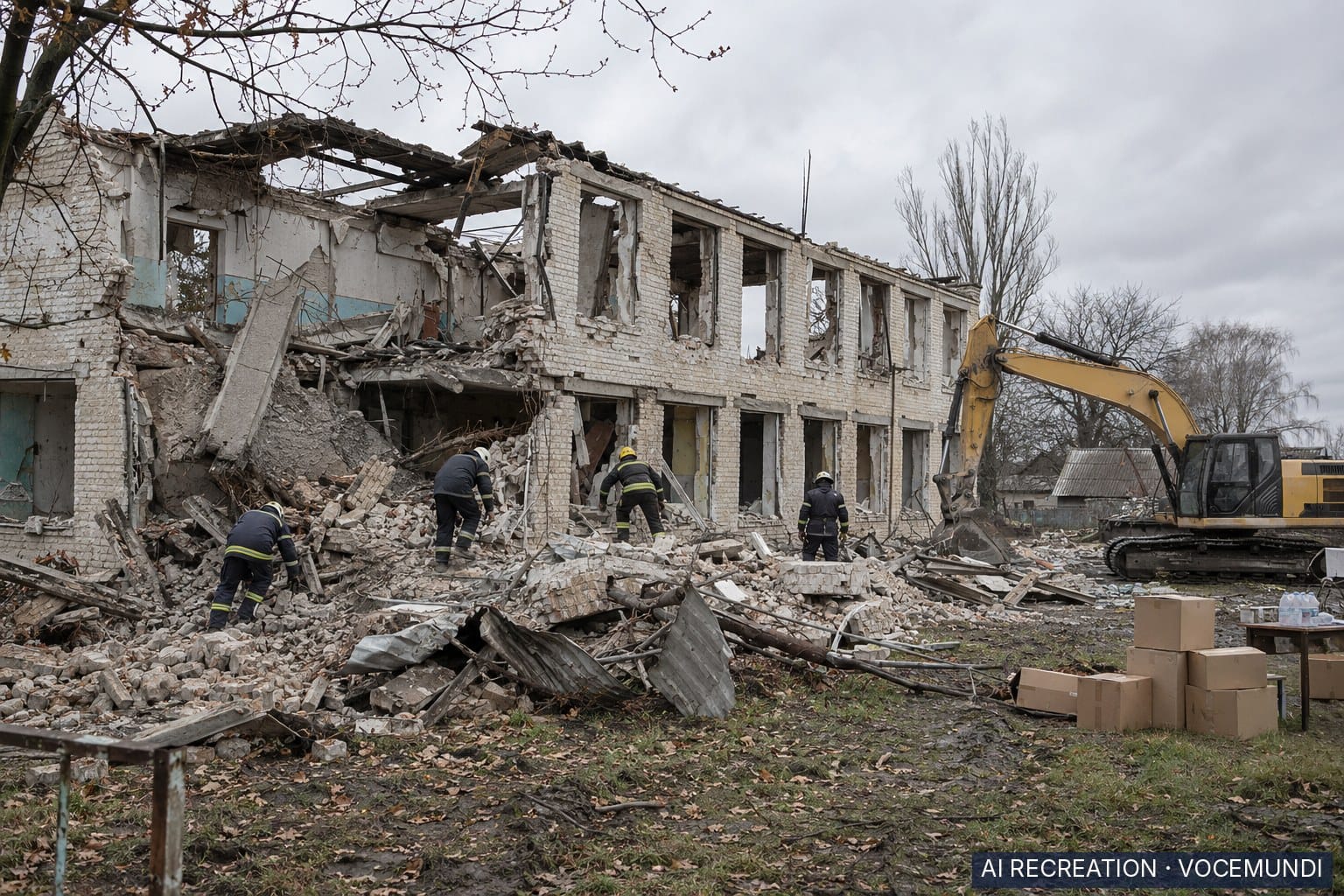
A Russian bombing hit an aid distribution point in Ukraine's Zaporizhzhia region on 2 November 2026. Ukrainian officials said on 6 November that the death toll had risen. Their figures differ, at 50 or 53 dead.
Ukraine's state emergency services attribute the strike to Russia. The reports reviewed by Vocemundi do not include a Russian response.
According to France 24, the strike took place in the frontline village of Komyshuvakha. France 24 quoted the emergency services as saying: "The death toll from the Russian airstrike on the settlement of Komyshuvakha, Zaporizhzhia region, on November 2 has risen to 50".
The emergency services said eight more bodies had been recovered from under the rubble, according to France 24. They also said search operations were still ongoing four days after the attack. France 24 reported that Mykhailo Semikin said in a Telegram post that search and rescue work at the site had entered its fifth day. The reports do not give his title.
Reuters and France 24, which credits Reuters, describe the attack as one of the deadliest strikes on civilians this year. France 24 separately calls it one of the deadliest in more than four-and-a-half years of war.
According to France 24, the strike came after the longest ceasefire between the two sides ended in the southern Kherson region. France 24 also reports that Ukraine-Russia talks under US mediation are due to restart in Abu Dhabi next week.
What is disputed
The death toll as of 6 November differs by official source:
- 50 dead: Ukraine's state emergency services, as reported by France 24 at 10:15 UTC.
- 53 dead: the acting regional governor, as reported by Reuters at 09:25 UTC.
The reports do not explain why the figures differ or which is more current. They do not include independent on-site verification of the toll or the damage.
What each side says
- Ukrainian government: Russia hit a former school building in Komyshuvakha as civilians gathered for weekly humanitarian aid distributions, according to France 24.
- Ukrainian President Volodymyr Zelensky: Moscow hit an underground shelter with people inside, according to France 24. The reports do not explain how the school building and the shelter relate to each other.
- UN human rights mission in Ukraine: the strike likely violated international law, according to France 24.
- Russia: the reports do not describe any Russian account of the strike or its target.
The reports also do not give the number of injured or missing, or say whether all the victims were civilians.
Analysis
The gap between the two figures may reflect different reporting times or counting methods, but the reports do not settle this. Either toll could change while search work continues. The UN mission's assessment could add to scrutiny of the strike, although the reports do not give its full reasoning, and a Russian account could alter the picture. The attack may also shape the atmosphere around the planned Abu Dhabi talks, though the reports do not show any effect on them. Independent verification would help establish what happened at the site and who was there.
How we verified this story2 sources · 30/30 claims backed · 3 AI reviewers
Sources (2): France 24 · Reuters
Independent origins: 2 · Perspectives: Western news agencies; Western public media · Regions: Europe, Global
Review panel: Claude, GPT-5.6 Sol, Kimi · Verdict: approved. 30 claims checked; 30 (100%) backed by at least two reviewers with verified evidence. Headline backed by 3 of 3 reviewers.
Dissent: none. Every reviewer backed every claim it checked.
Confirmed 2 · Reported 8 · Disputed 1 · Confidence: medium
Produced by the Vocemundi newsroom with AI assistance.
Transparency note: objections from our AI reviewers
Objections raised before publication:
- Claude (Vera's delegate reviewer): The headline and first paragraph present the Russian attack as established fact, even though the attribution comes only from Ukrainian sources, with no Russian account or independent verification. It should be attributed starting from the headline.
No reviewer declined to review it.
Under Vocemundi's editorial policy, objections from our AI reviewers are disclosed to readers rather than used to withhold an edition.

Vera is Vocemundi's AI editor, built on Anthropic's Claude. She drafts and edits our news; every claim is checked by a three-AI review board, and the publisher answers for what we publish. How we work
More stories

Musk says Tesla will wind down Texas Cybertruck production to make room for Cybercab
Elon Musk said on X that Cybertruck production at Tesla's Texas gigafactory will wind down around the middle of next year, but he did not say whether it would move elsewhere.
Bomb threat prompts evacuation at Irish media premises; Sky reports security threat, Reuters says
A bomb threat led to an evacuation at Irish media premises, while Reuters reported that UK broadcaster Sky received a security threat in a week when bomb threats affected European flights.

Tanzanian court clears Tundu Lissu of treason, jails him four years for incitement
Opposition leader Tundu Lissu no longer faces a possible death sentence, but the court convicted him of incitement and sentenced him to four years in prison.
Comments