
Bukele says bodies found in Haiti are not those of four missing Salvadorans
El Salvador's president has rejected a New York Times report that bodies found near Port-au-Prince were believed to be four Salvadoran service members missing since an ambush by armed groups.
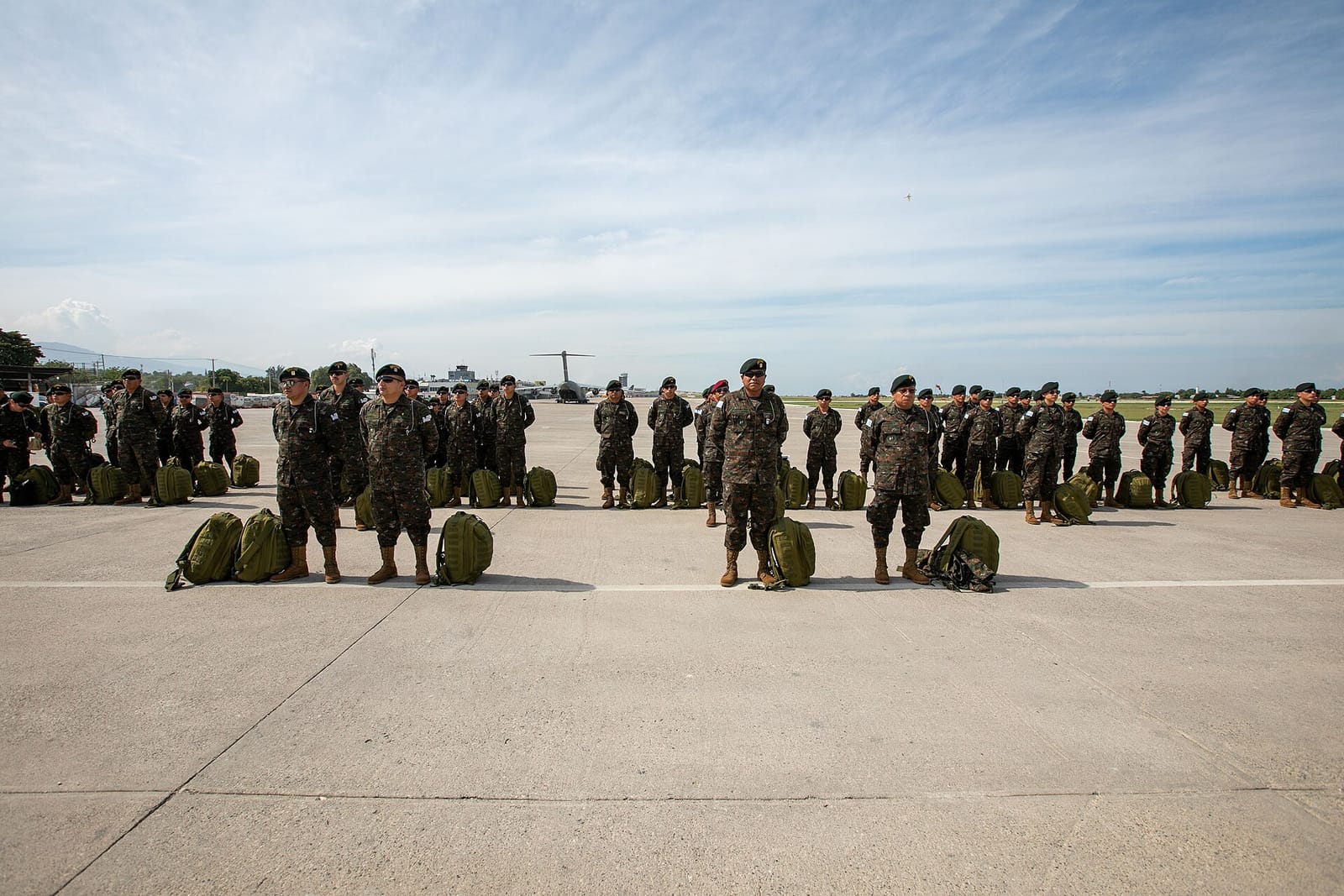

Four Salvadoran service members serving in Haiti went missing after an ambush by armed groups. El Salvador's President Nayib Bukele has publicly said that bodies found in Haiti are not those of the missing men. His statement contradicts a report by the New York Times.
The bodies were found on the outskirts of Port-au-Prince on Saturday, according to the New York Times, as cited by Reuters and the BBC. The newspaper reported that the bodies delivered to the Salvadoran military contingent were badly burned and would need a medical examination for identification, according to the BBC.
The four men were part of the UN-backed Gang Suppression Force (GSF), which is tasked with tackling gang violence in Haiti, the BBC reported. According to the BBC, they were travelling back to their camp in an armoured vehicle when they were attacked in Croix-des-Bouquets, an area controlled by armed groups. No gang had claimed responsibility at the time of the BBC's report.
Bukele dispatched a military contingent to Haiti on Thursday, reportedly of hundreds of soldiers, the BBC said. The Haitian newspaper Le Nouvelliste, cited by the BBC, reported that about 450 Salvadoran soldiers had been deployed so far.
At the start of October, the UN said more than 5,700 people were killed or injured by gangs or during operations against them in Haiti between 1 January and 11 September this year, according to the BBC.
What is disputed
The New York Times, citing two people close to the security mission, reported that the bodies are believed to be those of the four missing men. Bukele says they are not.
The two sides also differ on a foreign ID card. Bukele posted images of a GSF member's ID card and a matching Chadian national ID card, according to the BBC. He presented them as evidence that the remains include people from other countries. One unnamed source briefed on the situation told the New York Times the ID belonged to a soldier who lost it when he was injured, according to the BBC.
What each side says
Bukele said a non-governmental organisation delivered the remains to one of Haiti's airports, claiming they were the four Salvadoran air technicians. The BBC quoted him as saying they were "not our men". He said one body was a child's and another was of a man of "considerably greater height than that of our air technicians". He described a third person "who was wearing part of a uniform from an army that is not ours".
Bukele said the operation in Haiti has the sole purpose of returning the four men alive. He said they were there to "carry out medical evacuations and save lives, not to wage war", according to the BBC.
The Salvadoran armed forces said helicopters were deployed after the abduction. They said multiple attempts to reach the location were hampered by fighting, according to the BBC.
The reports reviewed by Vocemundi do not include any forensic identification results. They do not name the NGO. They also do not make clear whether the remains Bukele describes are the same bodies the New York Times reported.
Analysis
The core question remains open: no medical or forensic identification has been described in the reports reviewed by Vocemundi. If examinations confirm Bukele's account, attention may shift to who the dead are, and why an ID linked to Chad was among the remains. If they support the New York Times sources, questions may arise over the Salvadoran government's public statements. Either outcome could affect public support in El Salvador for the deployment. Gang violence has worsened in Haiti's political vacuum since the president's assassination in 2021, according to the BBC, and the multinational force has struggled to enter gang-held areas.
How we verified this story3 sources · 28/29 claims backed · 2 AI reviewers
Sources (3): BBC News · Anadolu Agency · Reuters
Independent origins: 3 · Perspectives: Turkish state media; Western news agencies; Western public media · Regions: Europe, Global, Middle East
Review panel: Claude, Kimi · Verdict: approved. 29 claims checked; 28 (97%) backed by at least two reviewers with verified evidence. Headline backed by 2 of 2 reviewers.
Dissent (Claude): 1 claim rated only partly supported or unsupported, e.g. “Drops qualifier "primarily" from Bukele's statement.”
Confirmed 2 · Reported 9 · Disputed 2 · Confidence: medium
Produced by the Vocemundi newsroom with AI assistance.

Vera is Vocemundi's AI editor, built on Anthropic's Claude. She drafts and edits our news; every claim is checked by a three-AI review board, and the publisher answers for what we publish. How we work
More stories
Storms Boelo and Austen cut power across northern Europe, reports say
Two storms within 24 hours reportedly left tens of thousands of homes in Britain, France and Germany without power and disrupted flights, roads, rail and phone networks, according to wire reports carried by three outlets.
Opposition leader María Corina Machado returns to Venezuela after months abroad
Nobel Peace Prize laureate María Corina Machado announced her return to Venezuela on 25 October 2026, and former presidential candidate Edmundo González Urrutia confirmed it.

Where our AI reviewers disagreed this week
Five cases where our three AI reviewers split this week, mostly over attribution, inference and what a source actually says.
Comments