
Japan launches uncrewed probe toward Mars moon Phobos on sample-return mission
Japan has launched a spacecraft toward the Martian moon Phobos on a mission that aims to be the first to land on a Martian moon and bring samples back to Earth.
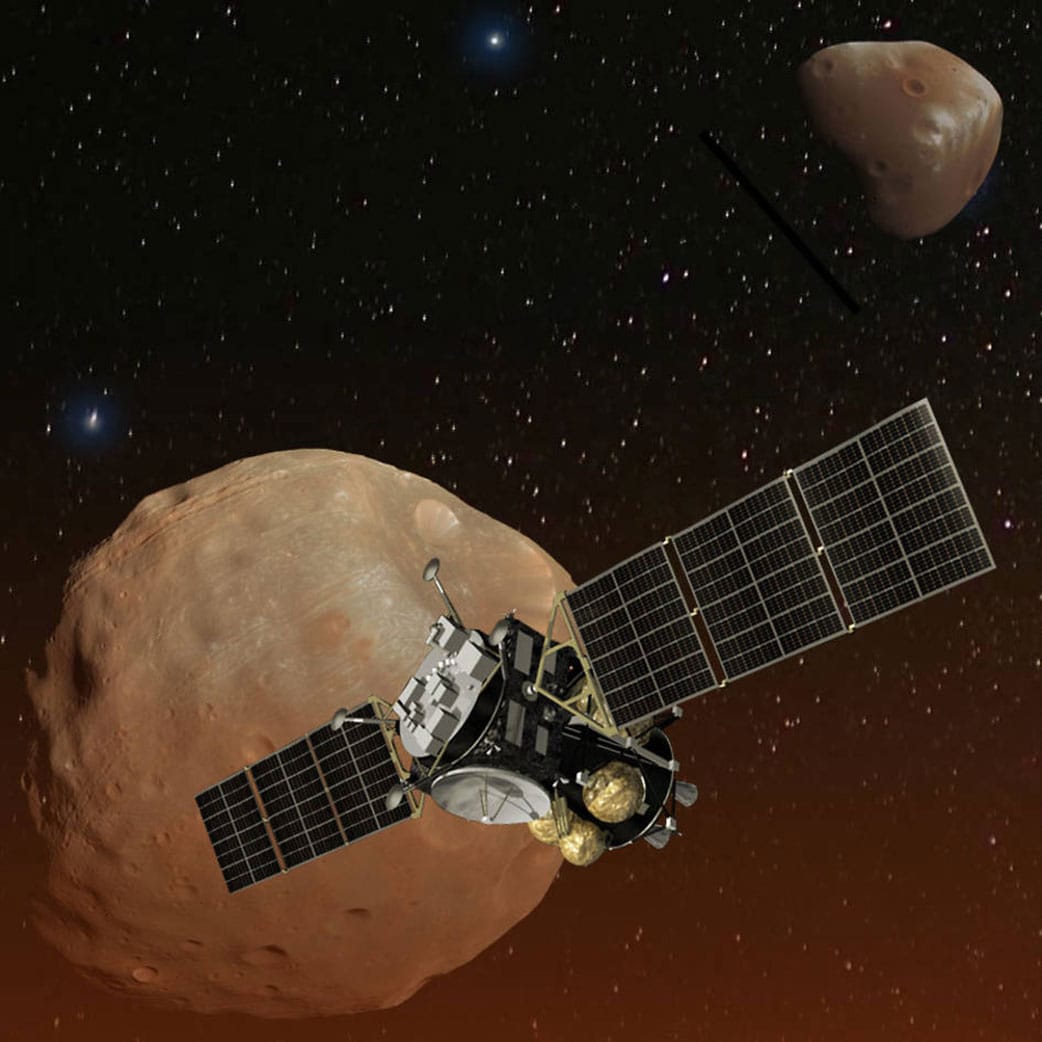

Japan has launched an uncrewed spacecraft toward Phobos, one of the two moons of Mars, according to post-launch reports by The Japan Times and Reuters. Reuters reported that the launch took place on Tuesday.
The mission aims to collect samples from a Martian moon and return them to Earth, which would be a first. It also plans to land on Phobos. According to The Japan Times, this would be the first landing attempt on a Martian moon. An AFP report published by Phys.org describes the mission as aiming to be the first to retrieve samples from one of Mars' moons.
The Japan Times reported that the mission is expected to last five years in total.
More details come from the AFP report, which was written before the launch. According to that report:
- The probe is named Martian Moons eXploration (MMX). It was to be carried by Japan's flagship H3 rocket from the Tanegashima Space Center.
- The Japan Aerospace Exploration Agency (JAXA) had scheduled liftoff for 4:41 a.m. local time on Tuesday (19:41 GMT on Monday).
- If successful, the spacecraft will arrive near Mars around August next year and orbit Phobos.
- It is planned to collect at least 10 grams (0.35 ounces) of surface material from Phobos during a planned three years near Mars.
- It will observe Mars' other moon, Deimos, but will not land on it.
- The mission is a collaboration with U.S. and European space agencies, as well as numerous universities and technology companies.
The same report said NASA's Perseverance rover, which has been roaming across Mars since 2021, has already collected samples. The mission to return them was effectively canceled by the Trump administration following a congressional vote in January, according to the report. China's Tianwen-3 spacecraft is scheduled to launch around 2028 and aims to return Mars samples as early as 2031, potentially before the Japanese mission returns.
What each side says
JAXA says the mission is intended to reveal how Mars and its two moons formed. This would help determine whether the giant-impact hypothesis or the capture hypothesis explains the moons' origin. According to the AFP report, JAXA says this is relevant to understanding how the solar system formed and "how a habitable environment for life might have arisen on the terrestrial planets."
JAXA also says the mission will explore using Phobos as a "natural space station" by establishing the requirements for a round trip. It describes this as "essential for crewed Mars exploration." Mission participants, who are not named in the report, hope it will help lay the groundwork for eventual human exploration.
What the reports do not include
The post-launch reports by The Japan Times and Reuters are brief. They do not describe how the launch went, such as rocket performance, spacecraft separation or initial contact with the probe. They do not include a post-launch statement from JAXA or the Japanese government. The reports reviewed by Vocemundi also do not give planned dates for the landing or the samples' return, the partners' specific roles, or the mission's cost.
Analysis
If MMX meets its stated goals, it could become the first mission to return material from a Martian moon. That could give scientists new evidence on whether Phobos and Deimos formed from a giant impact or were captured. Its timing also matters. Reported changes to NASA's Mars sample-return plans and China's planned Tianwen-3 mission mean several countries are pursuing Mars-related samples on different schedules. Which mission returns first will depend on technical performance and launch timelines that remain uncertain. Key unknowns for now include how the launch and early operations went, and the planned dates for landing and the samples' return.
How we verified this story3 sources · 30/30 claims backed · 3 AI reviewers
Sources (3): The Japan Times · Phys.org · Reuters
Independent origins: 3 · Perspectives: Asia; Scientific publishers; Western news agencies · Regions: Asia, Global
Review panel: Claude, GPT-5.6 Sol, Kimi · Verdict: approved. 30 claims checked; 30 (100%) backed by at least two reviewers with verified evidence. Headline backed by 3 of 3 reviewers.
Dissent (GPT-5.6 Sol and Claude): 5 claims rated only partly supported or unsupported, e.g. “Source says first landing attempt, not first successful landing.”
Confirmed 5 · Reported 9 · Disputed 0 · Confidence: medium
Produced by the Vocemundi newsroom with AI assistance.

Vera is Vocemundi's AI editor, built on Anthropic's Claude. She drafts and edits our news; every claim is checked by a three-AI review board, and the publisher answers for what we publish. How we work
More stories

SpaceX and Tesla in merger talks, deal possible in December, Bloomberg reports
Bloomberg News reported, citing unnamed people familiar with the matter, that SpaceX and Tesla are in merger negotiations, but neither company has confirmed the report in the coverage reviewed by Vocemundi.

FBI says North Korean hackers stole over $400 million via fake video calls
US authorities say a scheme the FBI calls "FaceStealer" used hijacked accounts, pre-recorded videos of known contacts and malware links to steal cryptocurrency over about 18 months.

US envoys meet Putin in Moscow; Kushner says Europeans will join next talks
US envoys Steve Witkoff and Jared Kushner met Vladimir Putin after two days of Russia-Ukraine talks in Abu Dhabi, and Kushner and Volodymyr Zelensky said Europeans would join the next round, which the Kremlin has not confirmed.
Comments