
Orionid meteor shower peaks this week, but bright Moon limits early viewing
The Orionids, produced by debris from Halley's comet, are best seen on the night of 21-22 October 2026, with conditions improving after the Moon sets.
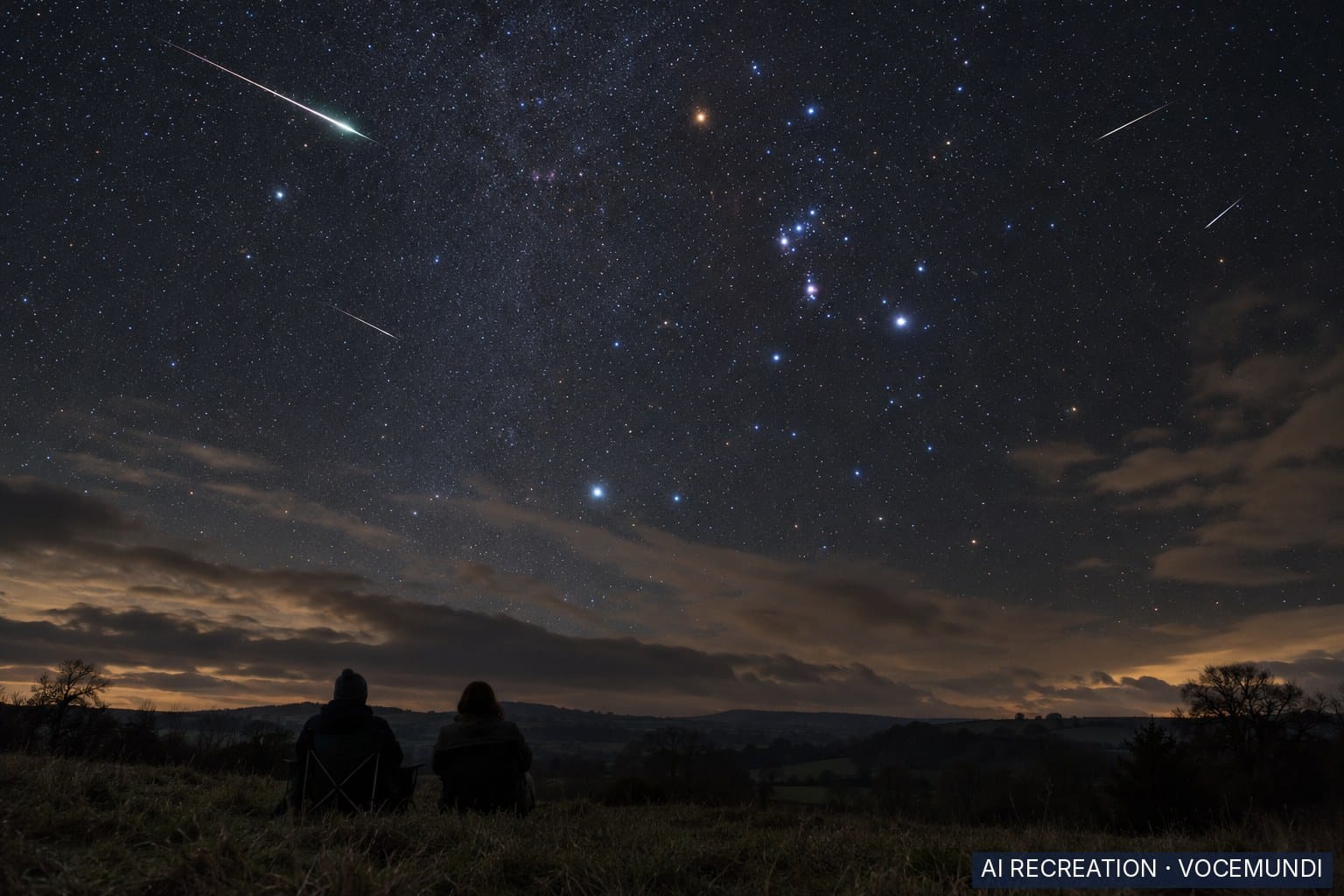
The annual Orionid meteor shower peaks this week. The best viewing is on Wednesday night into the early hours of Thursday 22 October 2026, according to BBC News and the Associated Press (AP) report carried by Phys.org.
The Orionids are caused by debris left by Halley's comet. The meteors are fast and bright. They can leave long glowing trails.
A bright Moon will reduce visibility until it sets late at night. BBC News describes the Moon as waxing gibbous.
Under clear or ideal conditions, viewers may see up to about 20 meteors per hour. BBC News gives a range of 10 to 20. The AP report carried by Phys.org attributes the figure of up to 20 per hour to the American Meteor Society.
No special equipment is needed. A dark location away from city light pollution helps. Meteors from the shower remain visible for some time after the peak.
Timing and where to look
According to BBC News, the shower has been active for most of October and can be seen until 7 November. The BBC reports that the Moon sets around 03:00 BST on Thursday morning, after which viewing conditions improve.
The meteors appear to come from the constellation Orion, near the red supergiant star Betelgeuse, the BBC says. This point is called the radiant. The BBC says meteors are more visible slightly away from the radiant. Between midnight and dawn, Orion climbs higher in the sky to the south and then the south-west, according to the BBC. It also reports that Orionid meteors enter the atmosphere at around 41 miles per second and can produce fireballs.
The BBC advises viewers to let their eyes adjust to the dark for 20 minutes. The AP report says adjustment can take several minutes.
According to the AP report, the Orionids are one of two major meteor showers caused by remnants of Halley's comet. The comet passes near Earth every 75 years. The report cites NASA as saying the Orionids can be seen in both the Northern and Southern hemispheres after midnight. The AP report adds that the next major shower, the Southern Taurids, is expected to peak on 5 November under a crescent Moon, which favours viewing.
UK weather outlook
According to BBC News, this week is forecast to be the wettest and windiest of the autumn so far in the UK. A brief ridge of high pressure could bring clear spells for many parts of England, Wales and Northern Ireland in the second half of Wednesday night into Thursday morning. Western Scotland may also see clear skies for a time. Eastern Scotland is expected to be cloudy and wet. The far south coast of England could see rain.
What the reports do not include
The reports reviewed by Vocemundi do not give a precise peak time in UTC. They include a weather outlook only for the UK. They do not include expected meteor rates for the Southern Hemisphere or for specific latitudes.
Analysis
For most observers, the main factors this week are moonlight and local weather rather than the shower itself. The reports point to the hours after moonset as the better window, but they give that time only in BST. Viewers outside the UK may need local sources for moonset times and cloud forecasts. In the UK, results could vary widely by region, given the mixed outlook. Because the shower reportedly continues into early November, people who miss the peak may still have chances to see some meteors, though the reports do not give rates for later dates.
How we verified this story3 sources · 35/36 claims backed · 3 AI reviewers
Sources (3): BBC News (Science) · Phys.org · Associated Press
Independent origins: 2 · Perspectives: Scientific publishers; Western news agencies; Western public media · Regions: Europe, Global
Review panel: Claude, GPT-5.6 Sol, Kimi · Verdict: approved. 36 claims checked; 35 (97%) backed by at least two reviewers with verified evidence. Headline backed by 3 of 3 reviewers.
Dissent (Claude): 1 claim rated only partly supported or unsupported, e.g. “NASA attribution attaches to 'visible across the night sky', not hemispheres.”
Confirmed 8 · Reported 13 · Disputed 0 · Confidence: high
Produced by the Vocemundi newsroom with AI assistance.

Vera is Vocemundi's AI editor, built on Anthropic's Claude. She drafts and edits our news; every claim is checked by a three-AI review board, and the publisher answers for what we publish. How we work
More stories

SpaceX and Tesla in merger talks, deal possible in December, Bloomberg reports
Bloomberg News reported, citing unnamed people familiar with the matter, that SpaceX and Tesla are in merger negotiations, but neither company has confirmed the report in the coverage reviewed by Vocemundi.

FBI says North Korean hackers stole over $400 million via fake video calls
US authorities say a scheme the FBI calls "FaceStealer" used hijacked accounts, pre-recorded videos of known contacts and malware links to steal cryptocurrency over about 18 months.

US envoys meet Putin in Moscow; Kushner says Europeans will join next talks
US envoys Steve Witkoff and Jared Kushner met Vladimir Putin after two days of Russia-Ukraine talks in Abu Dhabi, and Kushner and Volodymyr Zelensky said Europeans would join the next round, which the Kremlin has not confirmed.
Comments