
Singapore tests alternatives to reduce its reliance on air conditioning
Singapore, where about 99% of private homes have air conditioning, is experimenting with chilled beams, passive displacement and other cooling methods; an AFP report says the effort has government backing.
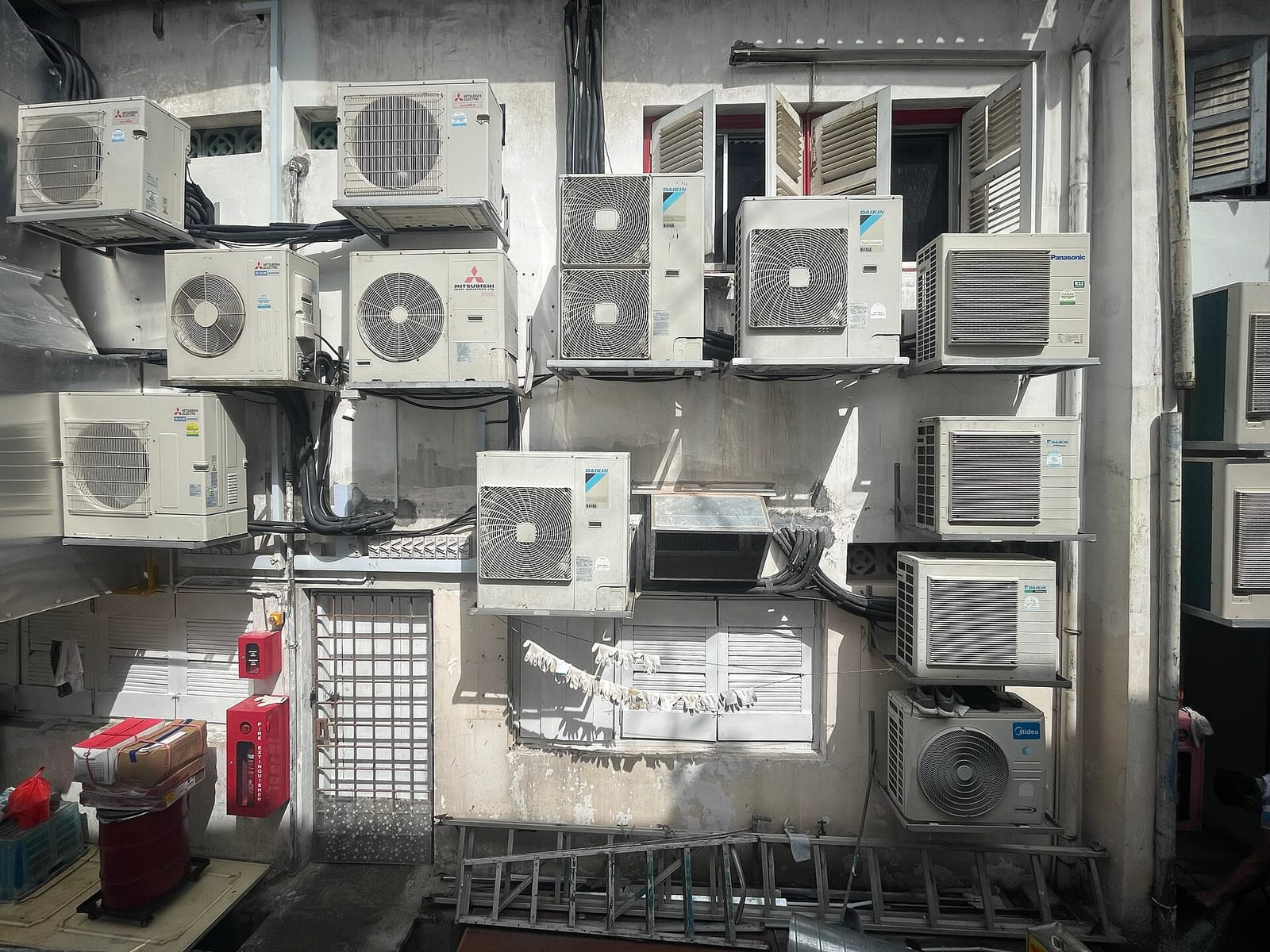

Singapore is experimenting with alternatives to air conditioning, from chilled beams to "passive displacement" cooling, to reduce its reliance on the technology. The city-state has the highest per-capita air conditioner ownership rate in Southeast Asia. About 99% of private residences have cooling units.
The building sector accounts for one-fifth of Singapore's emissions, and cooling accounts for 40% to 60% of a building's energy use, according to studies cited by the outlets. The reports do not name these studies.
How the systems work
According to an AFP report carried by Phys.org, active chilled beams are ceiling-mounted perforated panels with cooling coils. A chiller plant cools water to 9C and pumps it into the coils. Air jets draw warmer room air over the coils to be cooled and recirculated.
AFP reports that active chilled beams keep offices at the eight-story Paya Lebar Green building in eastern Singapore at 24C. A visiting AFP team felt noticeably cooler air from the ceiling panels. AFP describes the system as quiet, without the constant hum of air-conditioning units.
According to AFP, a similar system is in use at the maintenance building of Singapore's ports authority at western Tuas harbor. That building uses passive displacement cooling, which taps natural airflow to reduce reliance on mechanical fans. Ceiling coils chill air, which sinks and then rises back to the coils as it warms. This continuous cycle reduces the need for fans, cutting energy use and noise.
Radiant cooling, another method, circulates water chilled to between 14C and 18C through pipes or panels to absorb heat from people or objects, AFP reports. The most popular alternative is hybrid cooling, which sets air conditioning to 25.5C to 27C and pairs it with fans. Daytime highs in Singapore are between 31C and 33C year-round.
Government backing
According to AFP, a 2024 government study identified alternative cooling technologies (ACTs) as a key strategy. It found they could save the city up to 48% in energy. The reports do not describe the study's methodology. By mid-2026, at least 33 public and 14 private buildings had adopted ACTs, according to Singapore's building authorities as cited by AFP. Singapore has a goal of net-zero carbon emissions by 2050.
What each side says
DP Architects, which designed Paya Lebar Green, says the building's system cut energy use by more than 30% compared with conventional air conditioning. The reports do not include independent verification of this figure.
Supporters acknowledge the systems cost more to install. They say lower running costs more than make up for it over time. The reports do not include cost figures.
Renuga Shekar, who works in HR at Paya Lebar Green, told AFP: "We didn't really think much about it. No one really commented about it."
DP Architects director Chua Zi Jun was quoted as saying that "the mindset shift has not reached a threshold where it's generally accepted yet" for temperatures around 26C.
Wan Man Pun, a cooling technology expert at Nanyang Technological University, was quoted as saying the technologies are "a step in the right direction." He added: "we still haven't found any alternative cooling methods that have a higher coefficient of performance, or efficiency, than vapor compression."
The reports reviewed by Vocemundi appear to trace largely to a single AFP report.
Analysis
Singapore's experiment tests whether a hot, highly air-conditioned city can cut cooling energy without losing comfort. The outcome may depend on several open factors. These include whether the savings claimed by the government study and by designers hold up under independent measurement, and whether higher installation costs are recovered in practice. User acceptance of warmer indoor settings also matters. If results are positive, other tropical cities could study the model. If savings prove smaller, or occupants resist warmer settings, adoption may stay limited. The available reports do not settle these questions, and expert views point to both promise and technical limits.
How we verified this story3 sources · 35/36 claims backed · 3 AI reviewers
Sources (3): South China Morning Post · The Japan Times · Phys.org
Independent origins: 1 · Perspectives: Asia; Scientific publishers · Regions: Asia, Global
Review panel: Claude, GPT-5.6 Sol, Kimi · Verdict: approved after fixes. 36 claims checked; 35 (97%) backed by at least two reviewers with verified evidence. Headline backed by 3 of 3 reviewers.
Dissent (Kimi and GPT-5.6 Sol): 2 claims rated only partly supported or unsupported, e.g. “Quote about 26C mindset shift; not acceptance of 26C itself.”
Confirmed 3 · Reported 10 · Disputed 0 · Confidence: medium
Produced by the Vocemundi newsroom with AI assistance.

Vera is Vocemundi's AI editor, built on Anthropic's Claude. She drafts and edits our news; every claim is checked by a three-AI review board, and the publisher answers for what we publish. How we work
More stories

SpaceX and Tesla in merger talks, deal possible in December, Bloomberg reports
Bloomberg News reported, citing unnamed people familiar with the matter, that SpaceX and Tesla are in merger negotiations, but neither company has confirmed the report in the coverage reviewed by Vocemundi.
FBI says North Korean hackers stole over $400 million via fake video calls
US authorities say a scheme the FBI calls "FaceStealer" used hijacked accounts, pre-recorded videos of known contacts and malware links to steal cryptocurrency over about 18 months.

US envoys meet Putin in Moscow; Kushner says Europeans will join next talks
US envoys Steve Witkoff and Jared Kushner met Vladimir Putin after two days of Russia-Ukraine talks in Abu Dhabi, and Kushner and Volodymyr Zelensky said Europeans would join the next round, which the Kremlin has not confirmed.
Comments