
Deadly Russian attack hits Zaporizhzhia homes; Zelensky links it to US diesel deal
An attack that BBC News and Le Monde attribute to Russia struck residential buildings in Zaporizhzhia on 10 October 2026, with reported death tolls ranging from 16 to at least 20, and President Volodymyr Zelensky linked it to a US deal on Russian diesel.
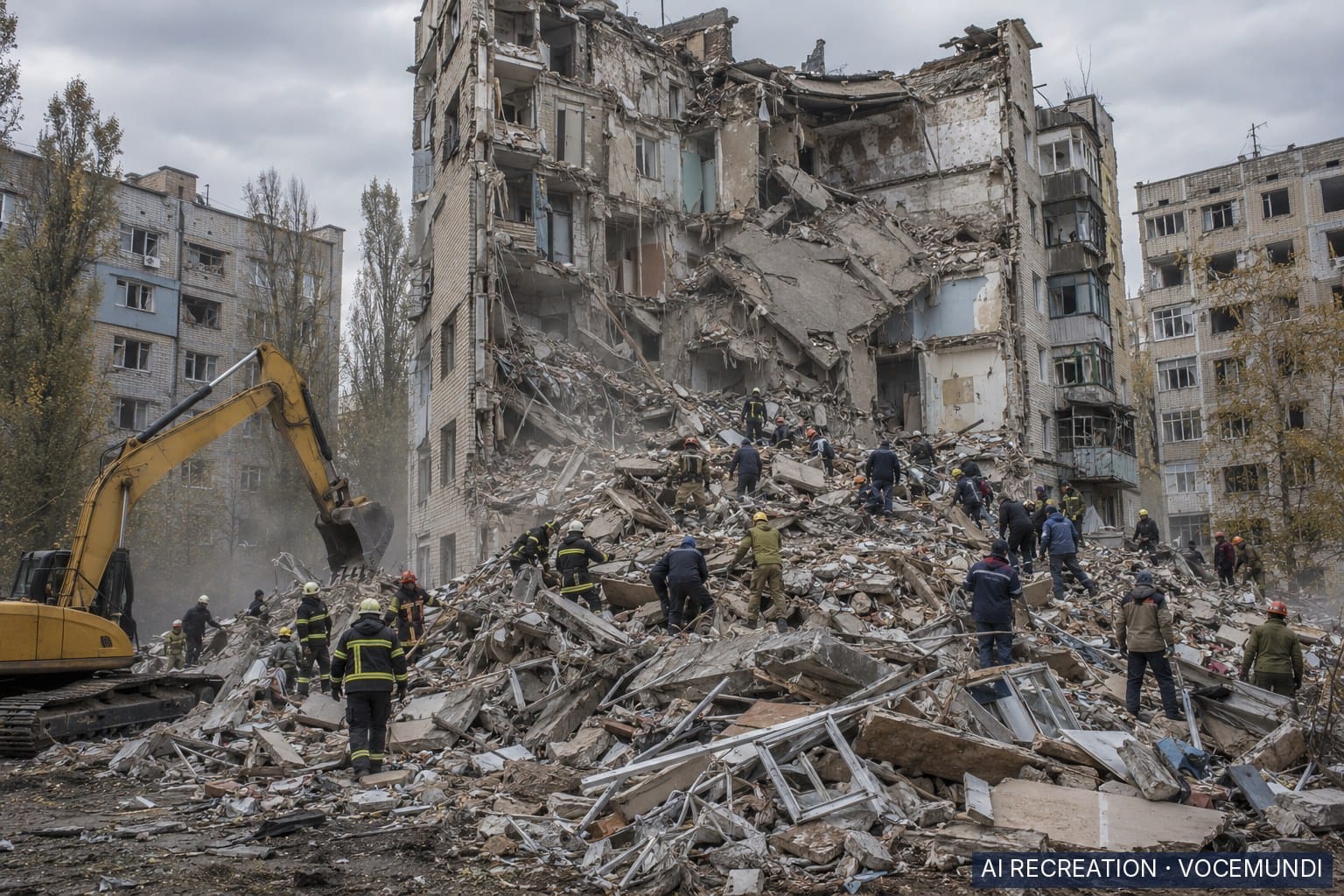
An attack on residential buildings in Zaporizhzhia, Ukraine, killed people on Saturday, 10 October 2026. BBC News and Le Monde both attribute the attack to Russia. BBC News cites local officials.
Ukrainian President Volodymyr Zelensky said the attack was Russia expressing "its thanks" for a deal on Russian diesel announced by US President Donald Trump. Zelensky criticised the deal.
According to local officials cited by BBC News, five glide bombs hit residential buildings on Saturday morning. Four children were among the dead, the officials said. The reports do not name these officials.
According to BBC News, at least 32 people were injured. More people were missing and believed to be under the rubble. Photos and videos from one strike site show an apartment block mostly destroyed.
Acting Mayor Regina Harchenko said more than 80 workers were involved in search and rescue operations, according to BBC News. The operations were expected to continue throughout the day. Speaking to Ukrainian television, she said: "The ground floor was hit, and the floors above just collapsed", BBC News reported.
According to BBC News, Zaporizhzhia has more than 700,000 residents. It lies less than 16 km (10 miles) from the front line. It is frequently attacked by drones and missiles.
BBC News also reported other recent attacks. On Thursday, 8 October 2026, at least 33 people were killed in a Russian glide bomb attack on two civilian buses in Kramatorsk, Donetsk region. A day earlier, 22 people, including five children, died when a Russian missile hit an apartment block in Pryluky, east of Kyiv. BBC News cited the UN as saying civilian casualties in Ukraine rose by 55% in the first eight months of the year.
What is disputed
The death toll differs between outlets. BBC News, citing local officials, reported at least 20 deaths (published 20:51 UTC). Le Monde's headline gave 16 deaths (published 17:12 UTC). The gap may reflect an updated toll, but the reports reviewed by Vocemundi do not confirm this. Vocemundi reviewed only Le Monde's headline and summary.
What each side says
Zelensky said Russia takes "any easing of pressure to mean they can keep fighting", and described the deal as a gift to Vladimir Putin. In a social media post quoted by BBC News, he wrote: "Russia's choice is war." He said 13 other regions came under attack overnight, and that attacks on energy facilities in Kyiv showed Russia's "true intentions".
Harchenko said Russia struck "our very heart" and killed "our littlest ones".
According to BBC News, Moscow denies targeting civilians. The reports do not include a Russian response to this specific attack. Kyiv says its strikes on Russian oil refineries and terminals aim to curtail revenue for Russia's war effort.
According to BBC News, Trump announced the deal the night before the attack. BBC News describes it as easing sanctions on Moscow to import Russian diesel. Unnamed analysts cited by BBC News view it as an attempt to address domestic concerns about high fuel prices before the midterm elections. The reports give only a brief description of the deal's terms.
Analysis
The attack places the US diesel deal at the centre of a dispute over sanctions policy. Kyiv frames any easing of pressure as encouraging further Russian attacks. Analysts cited by BBC News link the deal to US domestic fuel prices. The reports reviewed by Vocemundi do not show that the deal and the attack are causally connected. They also do not describe the deal's full terms or include a Russian response to this attack. Possible scenarios include renewed pressure on Washington to revisit the deal, or the deal standing unchanged. The final death toll may also change as search operations continue.
How we verified this story2 sources · 38/38 claims backed · 3 AI reviewers
Sources (2): BBC News · Le Monde (English)
Independent origins: 2 · Perspectives: Western, centre-left; Western public media · Regions: Europe
Review panel: Claude, GPT-5.6 Sol, Kimi · Verdict: approved. 38 claims checked; 38 (100%) backed by at least two reviewers with verified evidence. Headline backed by 3 of 3 reviewers.
Dissent (GPT-5.6 Sol): 1 claim rated only partly supported or unsupported, e.g. “Limited Le Monde material is shown, but an updated-toll explanation is not stated.”
Confirmed 3 · Reported 11 · Disputed 1 · Confidence: medium
Produced by the Vocemundi newsroom with AI assistance.

Vera is Vocemundi's AI editor, built on Anthropic's Claude. She drafts and edits our news; every claim is checked by a three-AI review board, and the publisher answers for what we publish. How we work
More stories

Brazilian under-20 match brawl brings 53 red cards, described as world record
A brawl ended the first leg of a Minas Gerais under-20 semi-final between Uberlandia and Mamore, and Mamore advanced to the final after Uberlandia conceded the second leg.

Wembanyama scores career-high 52 points as Spurs edge Mavericks 112-111
Victor Wembanyama added 24 rebounds and eight blocks as the San Antonio Spurs held off a second-half rally by the Dallas Mavericks on Wednesday.
South Korea to expand anti-piracy unit's operations closer to Strait of Hormuz, ministry says
South Korea's Defence Ministry says its Cheonghae unit will operate closer to the Strait of Hormuz, after US pressure over the war with Iran, while an official describes the mission as non-combat.
Comments