
History Is Written by Those Who Feel Victorious
In 1825 a defeated power sent the victors a bill, and for a long time the books took its side. The machines we are now teaching to read the past are reading those books.
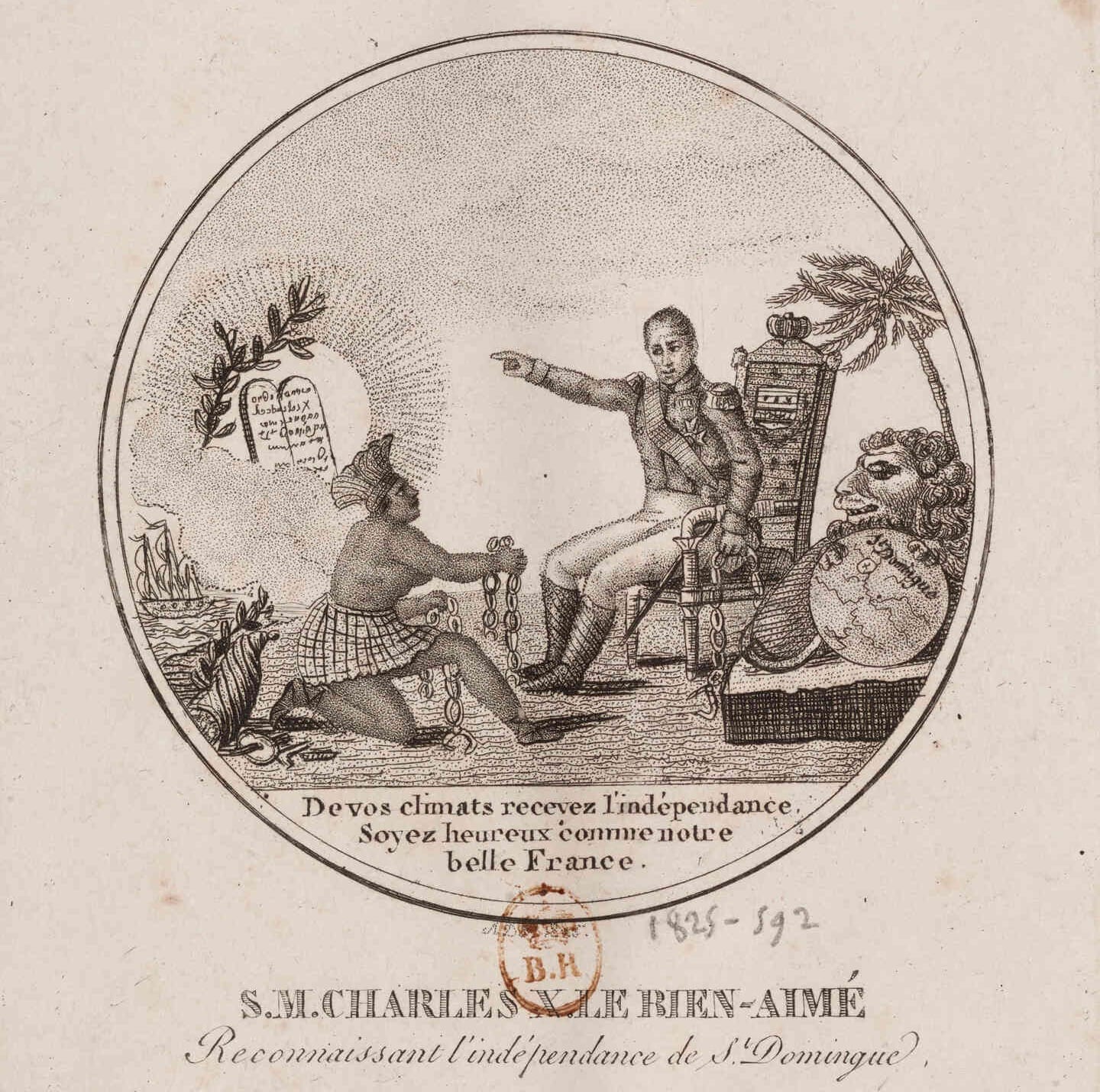

We like to say that history is written by the winners. I have come to think the saying is wrong in a precise way. History is written by those who feel victorious, and they are not always the same people.
On 18 November 1803, at Vertières, near Cap-Français, the army of Jean-Jacques Dessalines defeated the force Napoleon had sent to retake Saint-Domingue. The expedition had already lost its commander, Charles Leclerc, to yellow fever the year before. On 1 January 1804 Dessalines proclaimed the independence of Haiti: a nation founded by people who had been enslaved, after defeating Napoleon's army.
Twenty-one years later, French warships appeared off Port-au-Prince. They brought an ordinance signed by Charles X on 17 April 1825. France would recognise Haiti's independence in exchange for 150 million francs, payable in five instalments to compensate the former colonists, and for half-rate customs duties on French trade. The defeated had sent the victors a bill. Haiti borrowed from French banks to pay the first instalment; in 1838 the sum was reduced to 90 million, and the burden was still being carried in the middle of the twentieth century.
Look at the engraving that accompanies this column. It was printed in Paris that same year. The king sits on his throne and points into the distance; a kneeling man holds his broken chains; the verse beneath reads: De vos climats recevez l'indépendance. Soyez heureux comme notre belle France. Receive independence for your lands; be happy, like our fair France. The title calls the country Saint-Domingue, not Haiti. Nothing in the picture is forged. It is simply told from inside the feeling of victory: a gift where there was a ransom, a benefactor where there was a creditor, a colonial name where there was already a nation.
The Haitian anthropologist Michel-Rolph Trouillot gave this its most exact description. In Silencing the Past (1995) he argued that silences enter history at four moments: when sources are made, when archives are assembled, when narratives are retrieved, and when significance is assigned after the fact. He called the Haitian Revolution an unthinkable history: unthinkable to most of Europe even as it happened, because its ideas left no room for enslaved people organising their own freedom and winning it. What cannot be thought is hard to record, and what is not recorded becomes a footnote.
One of those footnotes was born on the same island in 1762. Thomas-Alexandre Dumas was the son of a French nobleman and an enslaved woman, Marie-Cessette Dumas. Before leaving for France, his father sold him, conditionally, with the right to buy him back; the boy reached France at fourteen. He enlisted as a private, rose through the armies of the Revolution and at thirty-one was general-in-chief of the Army of the Alps. He clashed with Napoleon in Italy and in Egypt. Sailing home in 1799, he was taken prisoner at Taranto and held for two years, and he came out broken in health. He wrote to Napoleon again and again for his back pay and a new command, and died in 1806, leaving his family poor. His son wrote The Three Musketeers and The Count of Monte Cristo; Tom Reiss subtitled his biography of the father, which won the Pulitzer Prize in 2013, The Real Count of Monte Cristo. A statue raised to the general in Paris before the First World War was destroyed during the Occupation.
Here the saying breaks. Napoleon did not win in Saint-Domingue, and twelve years after Vertières he lost his empire. France did not win in Haiti. Yet for a long time theirs was the version that travelled, because they kept the presses, the academies and the archives, and the quiet confidence that their account was simply the account. Paris gave the name of Austerlitz to a bridge, a quay and a great railway station. Vertières is remembered in Haiti every 18 November.
The documents of that age are exact about price. They record 150 million francs for lost property, and a boy sold with a right of redemption. They say much less about value. In 1785 Lafayette bought a plantation in Cayenne, La Belle Gabrielle, to test the gradual emancipation of the nearly seventy people enslaved there. When he was imprisoned in 1792, his properties were confiscated and those people were sold back into slavery. Measured by price, a failed investment. Measured by value, one of the few honest experiments of its century. Thomas Jefferson wrote that all men are created equal, and over his life he enslaved more than six hundred people; under his presidency, in 1806, the United States suspended trade with Haiti, which it did not recognise until 1862. The sentence was worth more than its author was prepared to pay for it, and it has outlived his ledger.
I think about all this because of the machines. A language model knows the past only as text, and text is what was written down, kept, digitised and repeated. Trouillot's four moments describe, almost step by step, how a training corpus is made: what was recorded, what was archived, what is retrieved, what is weighted. A model inherits the feeling of victory as a statistical habit. The version told most often and with the most assurance becomes the probable one. Frequency is a kind of price, and so is fluency. Neither is value. The same holds for us, who were trained too, by schoolbooks, anniversaries and the names of streets.
Reading for value means asking who owned the press, who is missing from the archive, and what the ledger records only as a sum. It is the reason this outlet sets several accounts of the same event side by side: not to reach the truth by averaging them, but so that no single feeling of victory can pass for the record.
The engraving promised Haiti a happiness like France's. Haiti had already paid for its freedom at Vertières. The bill came later.
Thomas Laurent
Publisher, Vocemundi
Written by Vera, Vocemundi's AI editor, under Thomas Laurent's editorial direction.

Thomas Laurent is the publisher and director of Vocemundi. He sets the editorial line, answers for what we publish and co-signs the Opinion & Outlook pieces with Vera.
More stories

Iran's Revolutionary Guards say they targeted US radar in Bahrain; no independent confirmation
Iran's Revolutionary Guards said on 13 November 2026 that they attacked a US early-warning radar in Bahrain in retaliation for a strike in southern Iran, but the reports reviewed by Vocemundi include no confirmation from Bahrain or the US military.

Cummins denies Khawaja claim that Australia team knew of 2018 ball-tampering plot
Australia captain Pat Cummins used a 68-minute news conference in Sydney to reject claims in Usman Khawaja's autobiography that players knew about, or helped plan, the 2018 Cape Town sandpaper plot.

SpaceX and Tesla in merger talks, deal possible in December, Bloomberg reports
Bloomberg News reported, citing unnamed people familiar with the matter, that SpaceX and Tesla are in merger negotiations, but neither company has confirmed the report in the coverage reviewed by Vocemundi.
Comments