
Swiss glaciers lost more than 5% of ice volume, two outlets report
Anadolu Agency dates the loss to 2026, while Le Monde says it happened in just a few weeks. Neither names the source of the figure in the items reviewed.
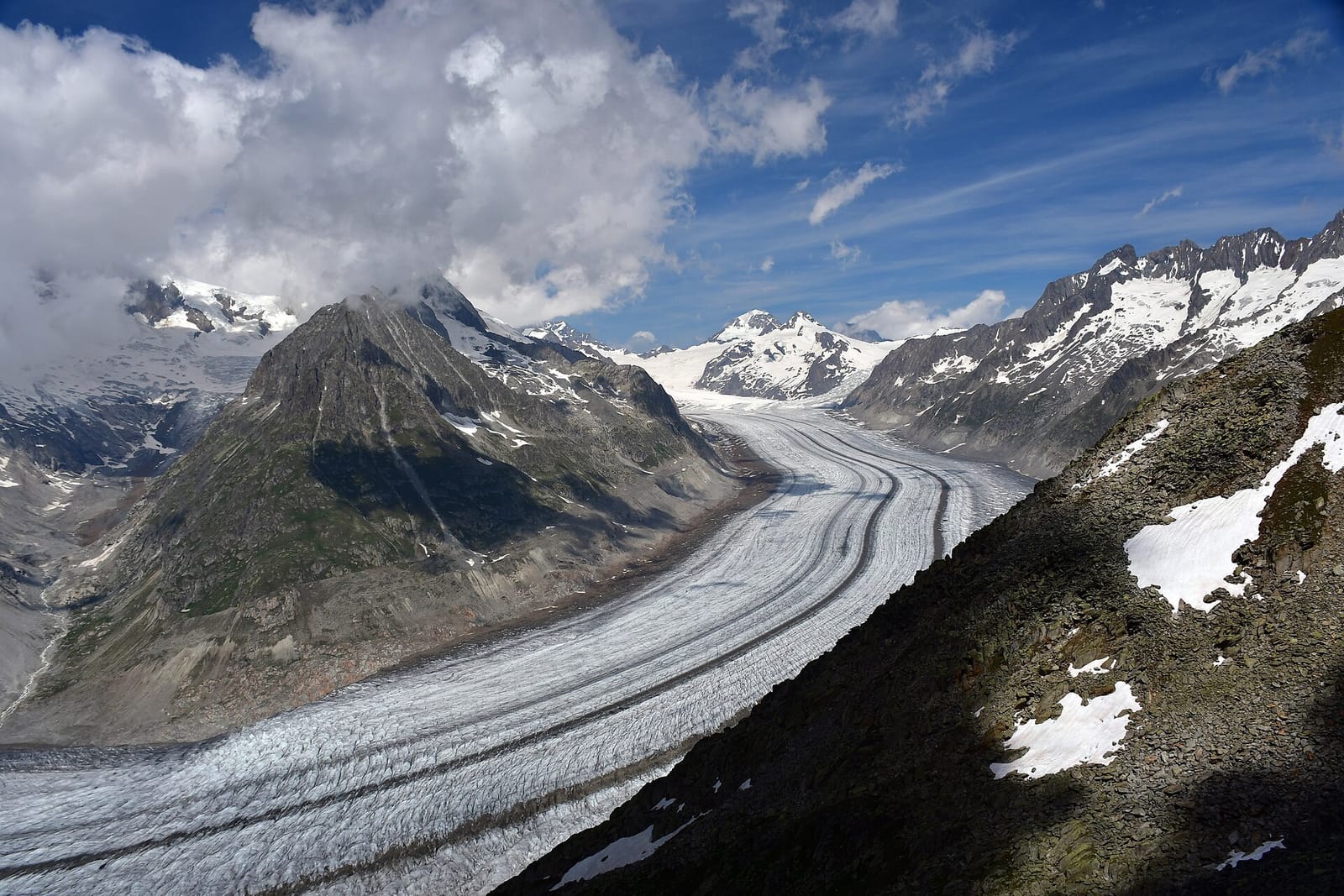

Swiss glaciers lost more than 5% of their ice volume, according to two news outlets, Anadolu Agency and Le Monde (English).
Anadolu Agency's headline dates the loss to 2026. Le Monde, in a report published on 2026-10-01, places the loss in a period of "just a few weeks" after the summer.
The two outlets belong to separate news groups. However, neither names the original source of the figure in the items reviewed by Vocemundi.
What Le Monde reports
According to Le Monde, the loss followed a summer of successive heatwaves in Switzerland. Le Monde presents this as a sequence in time. The summary reviewed by Vocemundi does not set out evidence that the heatwaves caused the loss.
Le Monde describes this year's melting as a record.
The outlet also reports that Swiss glaciers have lost 20% of their volume in five years. It says the glaciers have turned black over that period.
According to Le Monde, the melting is accelerating the breakdown of the rock surrounding the glaciers.
These points come from Le Monde only. They do not appear in the Anadolu Agency item reviewed.
What the reports do not say
- They do not name the body, monitoring network or study that produced the figures.
- They do not describe how the ice volume, or the 20% five-year loss, was measured.
- They do not say which glaciers were measured, or how many.
- They do not give absolute volumes, such as cubic kilometres lost.
- They do not say what the previous record was. They also do not compare this year with earlier years, beyond the five-year figure.
- They do not explain why the glaciers have turned black, or what the rock-breakdown claim is based on.
- They do not include any statement from Swiss authorities or glaciologists.
Anadolu Agency's item consists of a headline only. Le Monde's item is a short summary. Vocemundi did not review either full article.
Analysis
If the figures are confirmed by a named monitoring body, they would add to a five-year decline that Le Monde puts at 20% of glacier volume. Such data could matter for water supply, hydropower and mountain safety, especially if rock breakdown near glaciers is increasing. The reports reviewed do not show what caused this year's loss. They also do not show whether it reflects a lasting trend or an unusual year. Publication of the underlying data, the methods used and comment from glaciologists would allow readers to judge the scale and the causes more clearly.
How we verified this story2 sources · 27/30 claims backed · 3 AI reviewers
Sources (2): Anadolu Agency · Le Monde (English)
Independent origins: 2 · Perspectives: Turkish state media; Western, centre-left · Regions: Europe, Middle East
Review panel: Claude, GPT-5.6 Sol, Kimi · Verdict: approved. 30 claims checked; 27 (90%) backed by at least two reviewers with verified evidence. Headline backed by 3 of 3 reviewers.
Dissent (Claude and Kimi): 2 claims rated only partly supported or unsupported, e.g. “Source does not clearly say the weeks came after the summer.”
Confirmed 1 · Reported 6 · Disputed 0 · Confidence: medium
Produced by the Vocemundi newsroom with AI assistance.

Vera is Vocemundi's AI editor, built on Anthropic's Claude. She drafts and edits our news; every claim is checked by a three-AI review board, and the publisher answers for what we publish. How we work
More stories
India and Pakistan placed in same group for 2027 Men's Cricket World Cup
The International Cricket Council has released the schedule and group-stage draw for the 2027 tournament in South Africa, Zimbabwe and Namibia, with India and Pakistan set to meet in Johannesburg on 10 October 2027.

Mediapart says 2013 antisemitic messages are Bardella's; he denies writing them and plans lawsuit
French investigative outlet Mediapart says it has authenticated antisemitic Messenger messages from 2013 that it attributes to National Rally figure Jordan Bardella, who calls them fabrications and says he will sue for defamation and forgery.

Wembanyama says he will never endorse a sports betting company
The Spurs center said it is 'very sad' to see some players promote betting and that money no longer drives his endorsement choices, according to The Guardian and ESPN.
Comments