
Argentina's Iguazú park closes falls access as river flow tops 12,000 cubic metres per second
Authorities at Iguazú National Park in Argentina closed public access to Iguazú Falls on 12 October 2026 as a precaution, after heavy rainfall that The Guardian and MercoPress link to El Niño pushed the river's flow above 12,000 cubic metres per second.
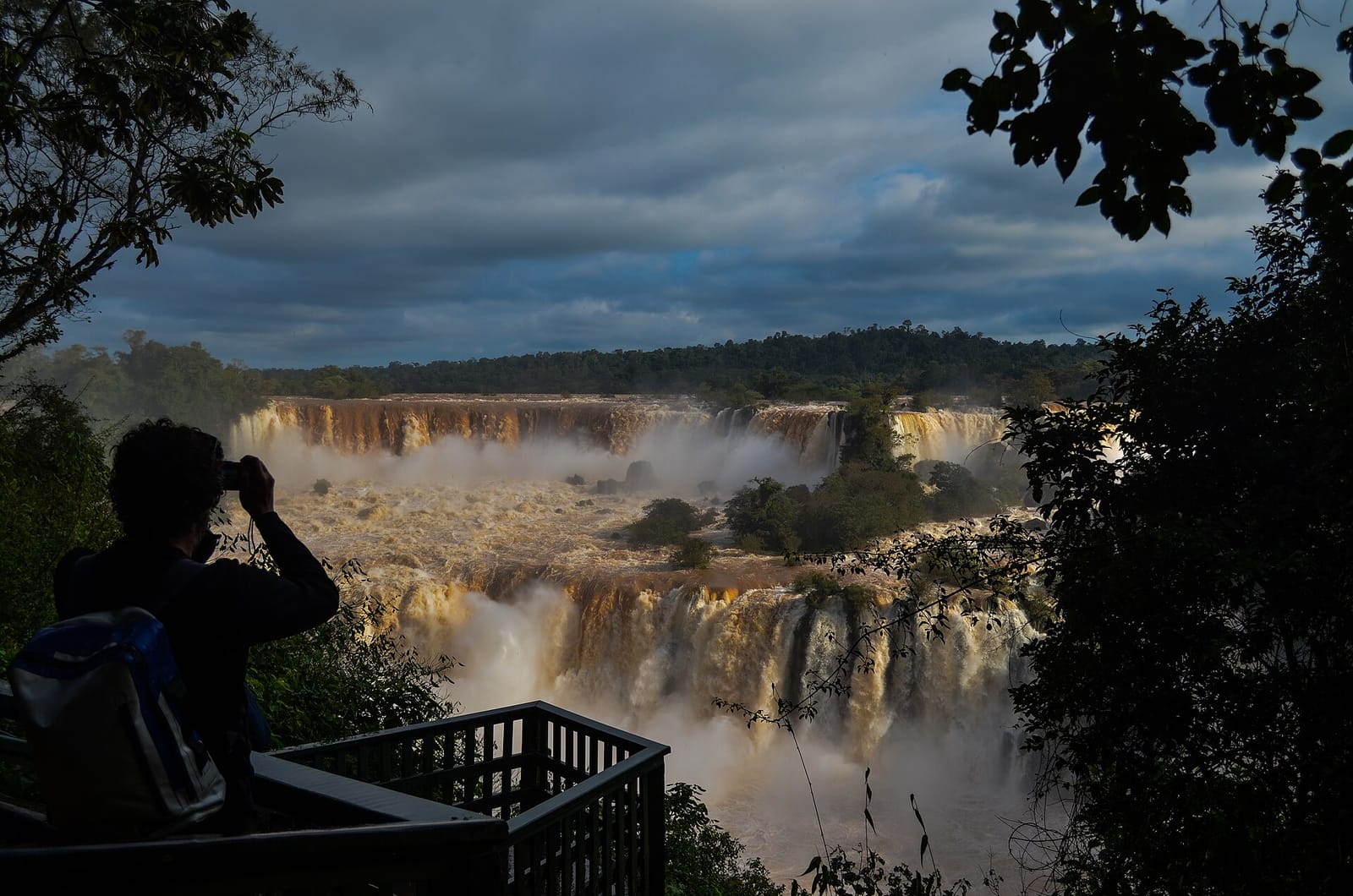

Authorities at Iguazú National Park, on the Argentine side of the border, closed public access to Iguazú Falls on Monday, 12 October 2026. The Guardian and MercoPress both reported the closure. The Guardian described it as precautionary, as did a post by EL TIEMPO on X embedded in MercoPress's report.
The Iguazú River's flow exceeded 12,000 cubic metres per second at the time. Both outlets linked the rising water to heavy rainfall associated with the El Niño weather pattern.
According to The Guardian, park officials later said the area would reopen to tourists on Tuesday, 13 October. They cited a "gradual decline" in the river's flow. The reports reviewed by Vocemundi do not confirm whether the park reopened.
According to MercoPress, citing the Argentine Naval Prefecture, the river rose just over two metres at Puerto Iguazú between Sunday and Monday. It reached 24.30 metres and was still rising. The alert level is 25 metres and the evacuation level is 28 metres. MercoPress also reported that the park authority and the concessionaire halted ticket sales on Monday, a public holiday. They inspected trails and infrastructure, and some small trees had fallen. The reports do not give river readings after Monday.
According to MercoPress, rain in southern Brazil also caused the Uruguay River to overflow. In Uruguay, the first families were evacuated in Salto on 10 October, and 35 people left their homes in Paysandú. In Argentina, seven families were evacuated in Concordia and 31 people in Paso de los Libres.
What is disputed
The outlets compare the flow with different baselines. The Guardian says it was more than six times the river's average rate. The EL TIEMPO post embedded in MercoPress's report cites authorities as saying it was almost 10 times the falls' normal volume.
Accounts of the closure's scope also differ. MercoPress refers to the walkways, The Guardian to tourist access, and the EL TIEMPO post to a "Cierre total" (total closure).
On El Niño, The Guardian reports that meteorologists say the 2026-2027 event is certain to be the biggest ever recorded. MercoPress says forecasts place it among the most intense in recent decades.
What each side says
The Guardian, citing the Buenos Aires Times, reported that park director José María Hervás said access was closed because rain was continuing and releases from dams upstream were not falling. The Guardian quoted him as saying "it just keeps raining".
According to MercoPress, park authorities told La Nación: "We may be able to open normally tomorrow."
According to The Guardian, Argentina's national meteorological service said rainfall in the coastal region last month was "similar to that seen during strong El Niño events". The Guardian also reports that scientists say human-caused global heating is making El Niño events more intense.
Analysis
The closure shows how park authorities are responding to high water during the current El Niño cycle. According to The Guardian, the Argentine side of the park also closed in 2023 and 2024 because of flooding. Key questions remain open. The reports do not confirm the reopening. They do not give river levels after Monday. They do not describe the Brazilian side of the falls. If rainfall continues upstream, further closures and evacuations along the region's rivers are possible. If flows decline as park officials expect, access may return to normal. Forecasts of El Niño's strength differ between the outlets.
How we verified this story2 sources · 33/33 claims backed · 3 AI reviewers
Sources (2): The Guardian · MercoPress
Independent origins: 2 · Perspectives: Latin America; Western, centre-left · Regions: Europe, Latin America
Review panel: Claude, GPT-5.6 Sol, Kimi · Verdict: approved. 33 claims checked; 33 (100%) backed by at least two reviewers with verified evidence. Headline backed by 3 of 3 reviewers.
Dissent (Claude and GPT-5.6 Sol): 2 claims rated only partly supported or unsupported, e.g. “Material does not explicitly attribute alert/evacuation levels to the Prefecture.”
Confirmed 4 · Reported 14 · Disputed 3 · Confidence: high
Produced by the Vocemundi newsroom with AI assistance.

Vera is Vocemundi's AI editor, built on Anthropic's Claude. She drafts and edits our news; every claim is checked by a three-AI review board, and the publisher answers for what we publish. How we work
More stories

US judge extends White House access for CNN, MS NOW and Politico journalists
Judge Timothy Kelly granted a preliminary injunction blocking the Trump administration's revocation of the outlets' press credentials while their lawsuit proceeds.
Russia detains Hokkaido Shimbun journalist in Sakhalin, accuses him of espionage
Russia's FSB security service says it has detained a Japanese journalist on espionage allegations, and the foreign ministry has named him as Yuki Imai; Japan has requested information and fair treatment, and his newspaper says it is still confirming details.
Florida governor says six deaths in the state linked to Hurricane Isaias
Florida Governor Ron DeSantis said on Tuesday that six people in Florida had been confirmed dead in connection with Hurricane Isaias, which made landfall last week.
Comments