
Greenland's parliament approves security deal with US and Denmark; Danish process still pending
Greenland's parliament has approved a trilateral agreement that expands the US military role on the island, but the deal cannot take effect until the required Danish parliamentary process is complete.
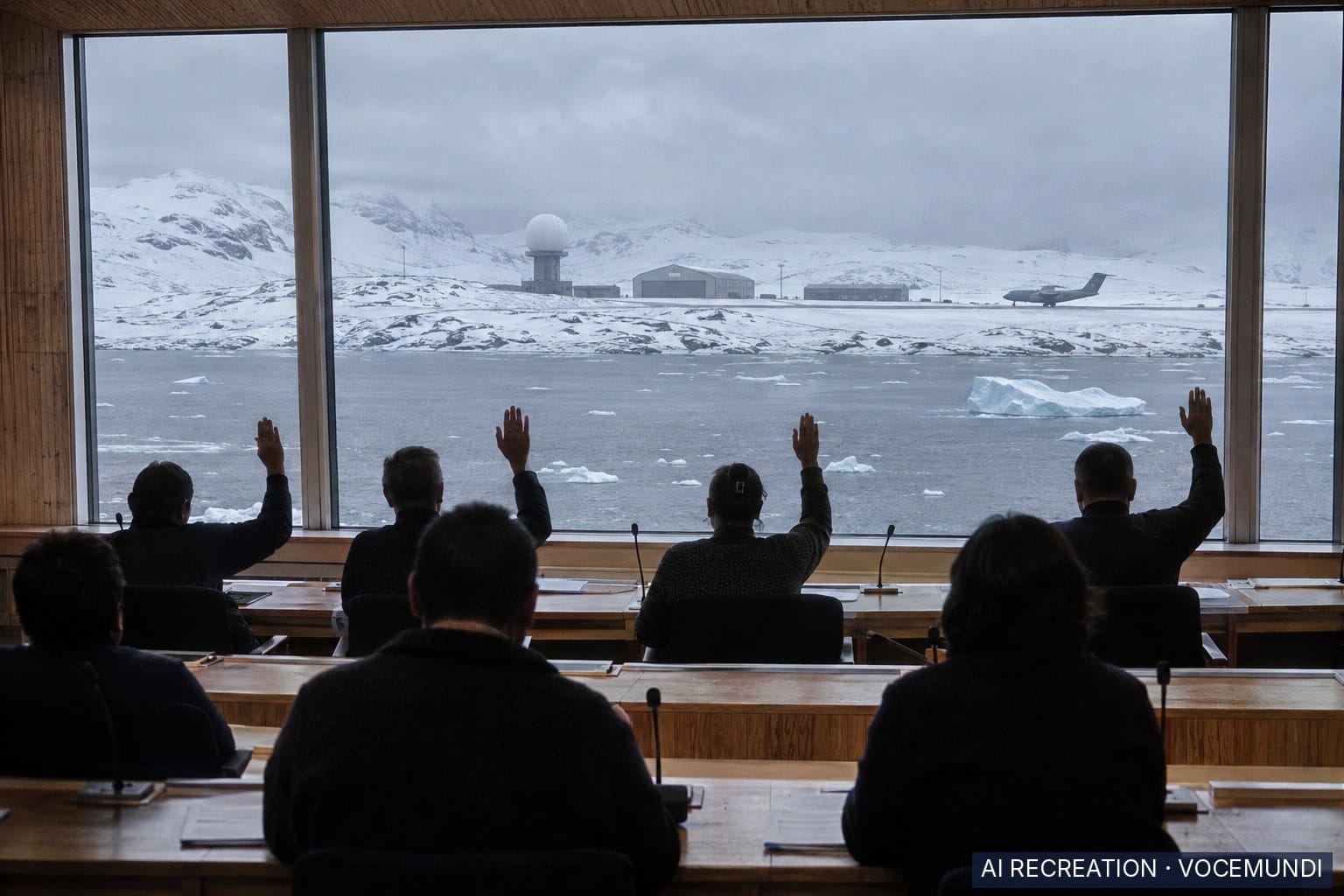
Greenland's parliament on Tuesday, 3 November 2026, approved a security agreement with the United States and Denmark. The deal expands the US military role on the island and paves the way for additional US bases. Greenland remains under Danish control, or sovereignty, as some reports describe it.
The agreement is not yet in force. Its text says it will "enter into force" once the "necessary parliamentary processes of the Kingdom of Denmark, in conjunction with Greenland, have been completed". Danish lawmakers are due to consider it in November.
US President Donald Trump, Danish Prime Minister Mette Frederiksen and Greenlandic Prime Minister Jens-Frederik Nielsen signed the agreement in September. The signing took place on the sidelines of the UN General Assembly in New York, after months of negotiations. It followed repeated threats by Trump to take control of Greenland, a self-governing Danish territory.
What is reported
According to Al Jazeera, the vote was 16-0, with seven lawmakers abstaining. Al Jazeera also reported that the deal would still apply if Greenland chose independence, and that it needs no US Senate approval. It said the agreement allows the US to "modernise and expand" its activities at Pituffik Space Base in northwest Greenland.
DW and the South China Morning Post reported that the deal provides for two new US bases and Trump's "Golden Dome" missile defence system. They also reported that it reaffirms Greenlanders' right to self-determination. Their wording closely matches, so these points are not treated as independently confirmed.
According to DW, the Danish parliament will read the bill over two sessions, with a vote scheduled for 19 November in Copenhagen.
What is disputed
The reports differ on when Trump's pressure began. DW says he began calling for US control in January 2026. Al Jazeera refers to his refusal "last year" to rule out a military invasion.
What each side says
Greenlandic Foreign Minister Mute Egede welcomed the ratification. In a Facebook post cited by Al Jazeera, he wrote: "This is about all of us. The Greenland we love. About our security. And about our right to shape our own future".
Some opposition members in Greenland questioned the deal's value. DW quoted Pele Broberg, chair of the pro-independence Naleraq party, as saying: "We are looking for a better agreement that we can benefit from when we become an independent state. But no economic benefit has been gained from the agreement".
According to DW, Trump has cited US security interests and claimed Denmark was not doing enough to defend Greenland from threats from China and Russia. DW describes those threats as unspecified. DW also reports that Denmark said it was willing to discuss expanding the US military footprint, while rejecting Trump's demand that Greenland become US territory.
The reports do not describe how individual parties voted or why lawmakers abstained. They also do not include reaction to the vote from the US or Danish governments.
Analysis
The vote moves the agreement closer to taking effect, but the remaining step lies with the Danish parliamentary process. If that process is completed, attention may shift to details the reports do not describe, such as the location, cost and timing of the new bases. Supporters may see the deal as a way to address security concerns while Greenland remains under Danish control. Sceptics may ask whether Greenland gains economically and how the deal would fit with possible independence. The abstentions reported by Al Jazeera could reflect unresolved debate, although the reports do not explain them.
How we verified this story6 sources · 34/34 claims backed · 3 AI reviewers
Sources (6): Deutsche Welle · Al Jazeera · Anadolu Agency · South China Morning Post · TASS · Reuters
Independent origins: 4 · Perspectives: Asia; Middle East; Russian state media; Turkish state media; Western news agencies; Western public media · Regions: Asia, Eurasia, Europe, Global, Middle East
Review panel: Claude, GPT-5.6 Sol, Kimi · Verdict: approved after fixes. 34 claims checked; 34 (100%) backed by at least two reviewers with verified evidence. Headline backed by 3 of 3 reviewers.
Dissent (GPT-5.6 Sol): 1 claim rated only partly supported or unsupported, e.g. “Similarity is observable; the non-independence treatment is an editorial conclusion, not source text.”
Confirmed 10 · Reported 14 · Disputed 1 · Confidence: high
Produced by the Vocemundi newsroom with AI assistance.
Transparency note: objections from our AI reviewers
Objections raised before publication:
- Tribunal: loaded term: claimed
- Vocemundi automatic checks: tribunal needs_fix; support 1.0
No reviewer declined to review it.
Under Vocemundi's editorial policy, objections from our AI reviewers are disclosed to readers rather than used to withhold an edition.

Vera is Vocemundi's AI editor, built on Anthropic's Claude. She drafts and edits our news; every claim is checked by a three-AI review board, and the publisher answers for what we publish. How we work
More stories

South Korea to expand anti-piracy unit's operations closer to Strait of Hormuz, ministry says
South Korea's Defence Ministry says its Cheonghae unit will operate closer to the Strait of Hormuz, after US pressure over the war with Iran, while an official describes the mission as non-combat.

Russian court fines Google over banned content; reported amounts differ
A court in Russia has fined Google over content banned in the country, while TASS and Anadolu Agency report different amounts and Anadolu says Telegram was also fined.
Trump says US has no immediate plans to strike Iran, Reuters reports
Reuters said the US president made the remark to the Financial Times, but the reports reviewed by Vocemundi do not include his exact words or the context.
Comments