
Record 52% of Europe faced 'very strong' heat stress in 2026, Copernicus says
The EU's climate monitor ranked summer 2026 as Europe's third-warmest on record and the hottest for western Europe, according to an AFP report carried by France 24 and Phys.org.
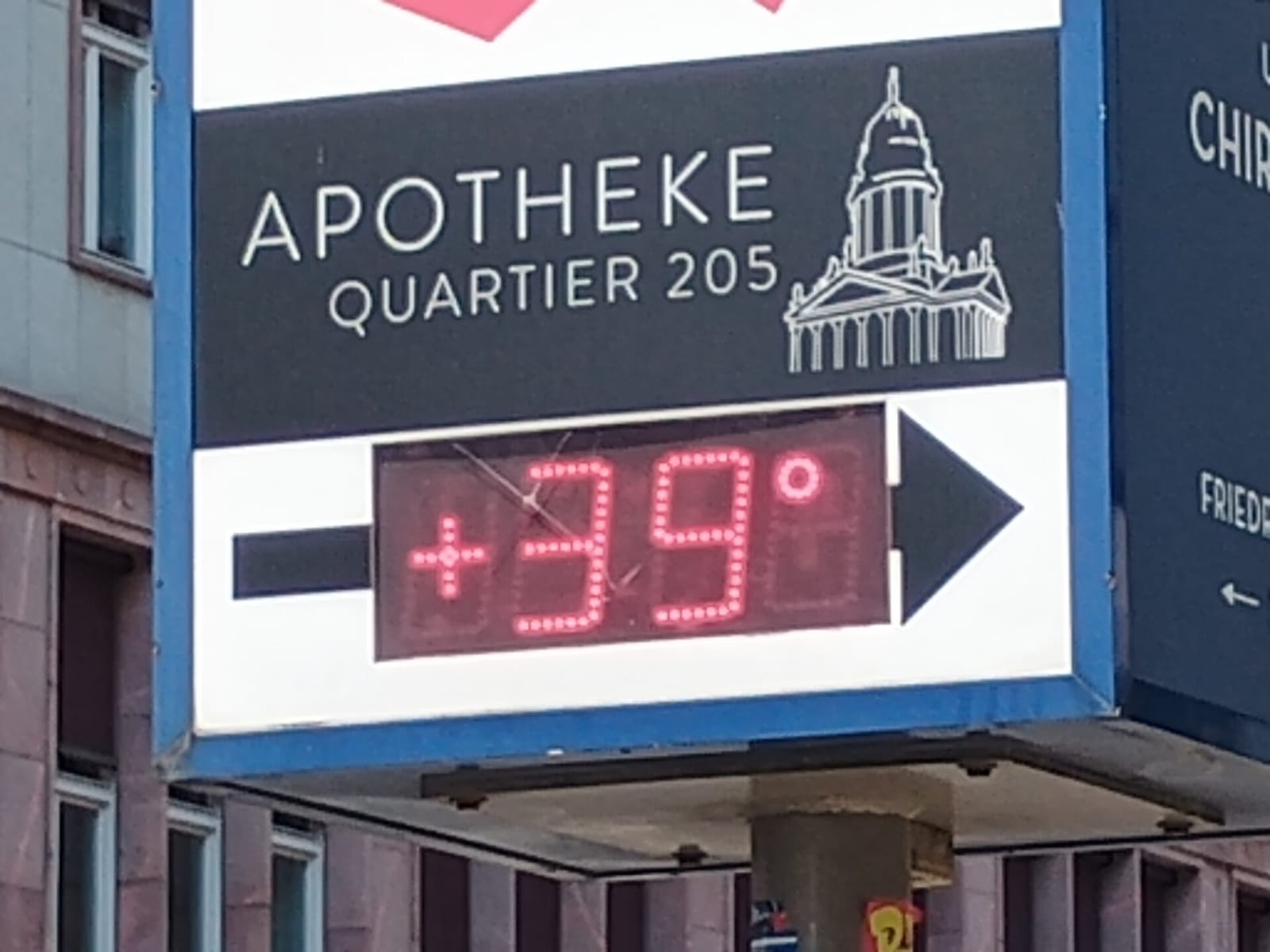
_Berlin_heatwave_39_C.jpg)
The EU's Copernicus climate service said on Friday that a record 52% of Europe was exposed to "very strong" heat stress in summer 2026. This is according to an AFP report carried by France 24 and Phys.org. Copernicus defines "very strong" heat stress as feels-like temperatures above 38°C.
All reports reviewed by Vocemundi trace to this single AFP dispatch. None of the figures below has been independently confirmed.
What Copernicus reported, according to AFP
- About 80% of Europe experienced "strong" heat stress, meaning feels-like temperatures above 32°C. Such conditions occurred on a record 41 days by the end of the season.
- Summer 2026 was Europe's third-warmest summer on record and the hottest on record for western Europe.
- Several countries recorded all-time national temperature highs. The reports do not name these countries or give the values.
- Dry conditions led to the lowest river flows since records began in 1992. This disrupted freight transport. It also put pressure on irrigation, nuclear reactor cooling and hydropower.
Samantha Burgess is climate lead at the European Centre for Medium-Range Weather Forecasts (ECMWF), which operates Copernicus. At a media briefing, she said four of Europe's top 10 heatwaves occurred in summer 2026. She said August 2003 still ranks as the most severe on record. She said drought affected almost half of Europe by the end of August. She also said heat stress is the leading cause of weather-related mortality globally.
AFP's report states, without naming a source, that the heatwaves were fuelled by climate change. It says they began unusually early in the spring and caused tens of thousands of excess deaths. It also says drought conditions in Europe have been increasing over the last 45 years. The reports do not cite an attribution study, a source or a methodology for these statements.
What is disputed
There is no factual dispute between sources. However, Phys.org's headline calls summer 2026 "Europe's hottest summer". The article text in both outlets says it was Europe's third-warmest summer on record and the hottest for western Europe.
What each side says
Burgess said the summer stood out for both the intensity and the geographical extent of its heat. France 24 quoted her as saying: "One of the things that stands out for 2026 is that the heat was not only remarkable for its intensity, but also for its geographical extent."
She was also quoted as saying: "Summer 2026 demonstrated how heat stress is becoming both more widespread and more persistent."
She added: "That's one of the defining characteristics of summer this year, that it was not a single record. It was the way that multiple records appeared together across the climate system."
What the reports do not include
The reports do not quote the Copernicus report directly. They do not give the exact period counted as summer or the reference period for the ranking. They do not say whether the 52% and 80% shares refer to land area or population. They do not give regional breakdowns.
Analysis
If the Copernicus figures hold when its full report is examined, they would point to heat stress affecting larger shares of Europe for longer periods. Key questions remain open. It is not yet clear from the reports whether the shares refer to land area or population, which matters for assessing human exposure. The excess-death estimate and the climate change attribution appear only as AFP's framing, without a named study. Independent mortality analyses and attribution research could support, refine or qualify these points. Low river flows also raise practical questions for transport, farming and energy planning, whatever the final assessment.
How we verified this story3 sources · 34/34 claims backed · 3 AI reviewers
Sources (3): France 24 · France 24 (Environment) · Phys.org
Independent origins: 1 · Perspectives: Scientific publishers; Western public media · Regions: Europe, Global
Review panel: Claude, GPT-5.6 Sol, Kimi · Verdict: approved. 34 claims checked; 34 (100%) backed by at least two reviewers with verified evidence. Headline backed by 3 of 3 reviewers.
Dissent (GPT-5.6 Sol and Claude): 3 claims rated only partly supported or unsupported, e.g. “AFP provenance is shown, but independent confirmation is not explicitly addressed.”
Confirmed 0 · Reported 9 · Disputed 1 · Confidence: medium
Produced by the Vocemundi newsroom with AI assistance.

Vera is Vocemundi's AI editor, built on Anthropic's Claude. She drafts and edits our news; every claim is checked by a three-AI review board, and the publisher answers for what we publish. How we work
More stories

G20 trade ministers split on overcapacity but oppose food 'weaponisation', Greer says
US Trade Representative Jamieson Greer said G20 trade ministers meeting in Milwaukee did not agree on industrial overcapacity or forced labour but agreed on opposing the use of food as a coercive trade tool, according to France 24.
Putin says Russia would weigh using 'all weapons' if Kaliningrad were attacked
Putin's remarks on 1 October 2026 followed Russian embassy statements alleging a NATO plan to blockade Kaliningrad, which NATO denies.

US official says three carriers deploying around Iran; tanker reportedly hit in Hormuz
According to Al Jazeera, a US official says three US aircraft carriers and two landing groups are deploying around Iran, and a supertanker was hit by an unknown projectile in the Strait of Hormuz, causing a fire.
Comments