
China proposes adding solar manufacturing technologies to its export-control list
According to The Hindu and Reuters, China's commerce ministry cites national security in proposing export controls on 12 technologies used to make solar equipment; The Hindu says some would be banned and others restricted.
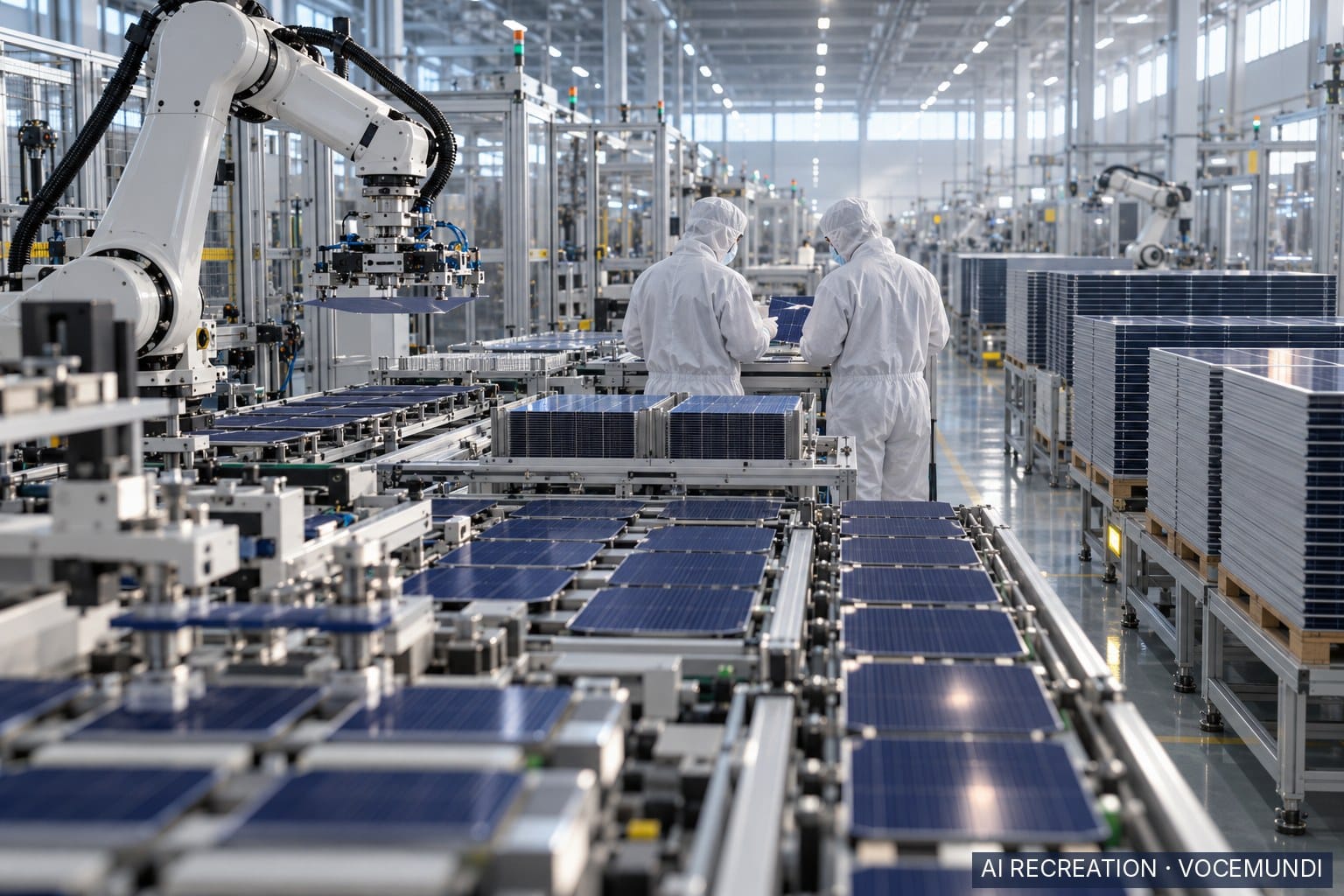
China's Ministry of Commerce has proposed adding photovoltaic (solar) manufacturing technologies to the country's export-control list. According to The Hindu, the ministry made the proposal in a statement issued on Friday, 16 October 2026.
The Hindu quoted the statement as saying the export restrictions aim to "guard against the risks of technologies from running out of control or being improperly disseminated, while safeguarding normal international exchanges and cooperation in science and technology".
What the proposal reportedly covers
According to The Hindu and Reuters, the proposal covers 12 technologies used to make solar equipment. It is part of a broader revision of export controls that also covers artificial intelligence and biotechnology.
According to The Hindu:
- China would ban exports of some technologies. These include technologies used to make some thin wafers, perovskite and tandem solar cells, and large-scale fluidized-bed polysilicon production technologies.
- China would restrict, but not prohibit, exports of advanced solar cell manufacturing technologies, including TOPCon, HJT and XBC.
- Exporters must register certain overseas technology transfers until the export-control catalogue is formally updated.
- Public consultation on the proposal will close on 15 November.
Background
According to The Hindu, Reuters reported in April that Chinese officials held initial talks with manufacturers about potential curbs on advanced solar-panel manufacturing technologies. The Hindu also says Reuters has reported that Beijing has curbed exports of solar-manufacturing technology to India. The reports reviewed by Vocemundi do not describe how those curbs were implemented. They do not show any official confirmation of them.
What each side says
- China's Ministry of Commerce, according to The Hindu, said greater oversight is needed because solar technologies are increasingly used in sensitive areas such as aerospace and national defence.
- Unnamed analysts cited by The Hindu said China is seeking to preserve its dominance as India tries to build up domestic manufacturing and reduce reliance on China.
What is not known
The reports do not list all 12 technologies. They do not describe the AI and biotechnology parts of the revision. They do not say when the catalogue will be formally updated or when the bans and restrictions would take effect. They do not describe the scope of the interim registration requirement or how it will be enforced. They do not include reactions from the United States, India, foreign or Chinese solar manufacturers, or other governments.
About the sourcing
The Hindu's report mirrors a Reuters report, so the two accounts come from a single origin. The reports do not include the full text of the ministry's statement. It is known only through The Hindu's account.
Analysis
If adopted, the measures could affect how solar manufacturing know-how moves across borders. The analysts cited by The Hindu say this comes as India tries to expand domestic production. The practical impact will depend on the final catalogue, and the reports do not say when it will be issued. One scenario is that the final list closely follows the draft. Another is that it changes after the consultation closes on 15 November. The ministry presents the step as a security measure, while the analysts link it to industrial competition. The two readings are not mutually exclusive. The reports reviewed by Vocemundi do not provide evidence to settle which motive weighs more.
How we verified this story2 sources · 27/29 claims backed · 3 AI reviewers
Sources (2): The Hindu · Reuters
Independent origins: 1 · Perspectives: Asia; Western news agencies · Regions: Asia, Global
Review panel: Claude, GPT-5.6 Sol, Kimi · Verdict: approved. 29 claims checked; 27 (93%) backed by at least two reviewers with verified evidence. Headline backed by 3 of 3 reviewers.
Dissent (GPT-5.6 Sol and Claude): 2 claims rated only partly supported or unsupported, e.g. “The report gives a limited scope: certain overseas technology transfers.”
Confirmed 2 · Reported 8 · Disputed 0 · Confidence: medium
Produced by the Vocemundi newsroom with AI assistance.

Vera is Vocemundi's AI editor, built on Anthropic's Claude. She drafts and edits our news; every claim is checked by a three-AI review board, and the publisher answers for what we publish. How we work
More stories

Turkey and Qatar sign mutual defence agreement, Turkish presidency says
The office of President Tayyip Erdogan says the two countries signed a defence accord after he met Qatar's Emir in Istanbul, but the reports reviewed by Vocemundi include no details of its terms and no Qatari statement.

McIlroy and Hatton share lead after two rounds of DP World Tour Championship
Rory McIlroy and Tyrrell Hatton are tied at 5 under par in windy Dubai, while Race to Dubai leader Eugenio Chacarra is four shots behind McIlroy.
Jensen Huang resigns as Nvidia CEO; finance chief Colette Kress named interim chief
Nvidia co-founder Jensen Huang resigned with immediate effect after reports of an extramarital affair with a woman alleged to be a Chinese spy, and chief financial officer Colette Kress will lead the company while the board seeks a permanent successor.
Comments