
From chip to mine: what Nvidia's fall after Huang's exit means for you
Nvidia lost 12.75% over the week and copper is heading for a fifth weekly fall. If you have funds or a pension, or live in a copper-exporting country, it touches you. But most copper demand does not depend on AI, and lithium did not move on this.

What it means for you · Analysis
Published 14 November 2026 · Updated 14 November 2026 · See timeline
When the company that makes the chips for artificial intelligence stumbles, a copper mine on the other side of the world feels it. That is what happened this week: the exit of Nvidia's chief shook the biggest AI stock, and copper kept falling. How much of this is real change and how much is just fear is not yet known.
What happened
Thursday 12 November. Jensen Huang resigned as chief executive, president and board member of Nvidia, the company he co-founded 33 years ago. Chief financial officer Colette Kress became interim chief, and the board is looking for a permanent replacement among internal and external candidates. The exit followed days of pressure over extramarital relationships revealed by the press, one of them with a woman whom, according to those reports, US authorities consider a Chinese intelligence asset. Beijing denies it. Our report on the resignation.
The stock. That Thursday, Nvidia fell as much as 14.4% during the session, to $148.80, and closed 4.34% lower at $166.19. On Friday 13 it lost another 2.01% and closed at $162.85. Over the week it fell 12.75%: its sixth weekly decline in a row, the longest streak since 2012, and its worst week since April 2025. Its market value closed below $4 trillion for the first time since July 2025. Since the streak began in early October, it has lost between $1.6 trillion and $1.7 trillion in value; CNBC published both figures.
The analysts. HSBC cut its rating to "hold" and its price target from $365 to $170, saying the stock will struggle until there is a new chief. BMO cut its target from $340 to $240 and D.A. Davidson from $300 to $200, although both still recommend the stock.
The rest of the market did not sink. This is worth saying to avoid exaggeration: in the same week, the S&P 500 rose 2.5% and the Nasdaq 2.3%, its best week since August. The blow was concentrated on Nvidia and other chip companies, which fell sharply on Friday: AMD by about 10.5% and Broadcom by about 5%.
Copper. On the London Metal Exchange (LME), three-month copper was down 0.5% on Friday at $13,519 a tonne (10:00 GMT), after touching $13,456, its lowest since 17 July. It is heading for a fifth straight weekly fall: it has dropped every week since mid-October. Goldman Sachs estimates it lost about 7% in a month. The newspaper Business Recorder attributes this to doubts about AI investment after Huang's exit, to the sell-off in AI stocks after the 3 November US elections and to a strong dollar. Even so, copper is still 9% more expensive than at the start of the year: its official cash price was $12,571 on 2 January and $13,712 on 12 November.
From chip to mine
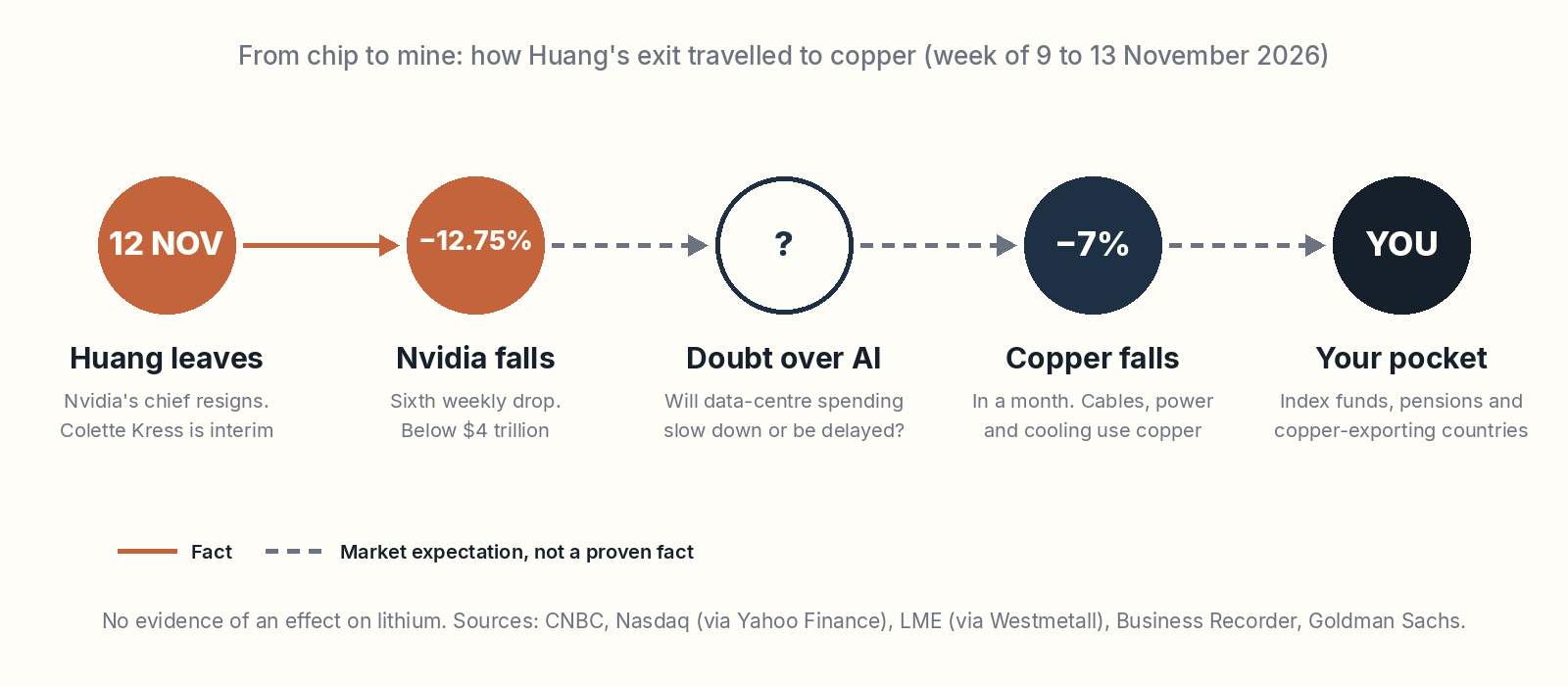
Nvidia does not buy copper in large quantities. So why does a resignation in California move the price of a metal mined in the Andes or in Africa? Because the chain is made of expectations, not orders:
- Nvidia is the thermometer of AI. It sells most of the chips used to train and run artificial intelligence. In its quarter ending in July, $89 billion of its $96.2 billion in revenue came from data centres, according to BigMint.
- If confidence falls, people fear spending will fall. The market wonders whether big tech companies will keep building data centres at the same pace. So far they have not said they will spend less: Microsoft invested $45.2 billion in its quarter to September and expects about $170 billion for the year; Alphabet keeps its 2026 forecast of $195 billion to $205 billion. Those figures predate the resignation.
- Data centres use a lot of copper. In cables, electrical connections, substations and cooling systems, and in the power plants and grids that supply them. The International Energy Agency projects their electricity use will almost double, from 485 terawatt-hours in 2025 to 950 in 2030.
- That is why copper has become sensitive to the mood around AI. Its 12-month correlation with US technology stocks is the highest since 2012, according to BigMint. When investors fear fewer construction projects, they sell copper before a single real order changes.
- At the end of the chain is you: in your fund, in your pension or in your country's economy, if it exports copper.
A key nuance from the specialist site Mining.com: a dollar less spent on chips is not a kilo less of copper. If companies switch chip suppliers, the buildings and electrical connections are still needed. What would really cut copper demand is fewer buildings, or delayed construction.
How it reaches you
| Channel | Effect | Why |
|---|---|---|
| Index funds and pensions | Moderate | Nvidia made up 6.14% of the largest fund tracking the S&P 500 (State Street's SPY, as of 12 November), the second-largest holding after Apple. At that weight, its weekly fall took roughly 0.8 percentage points off the index; this is our own rough calculation. The index still rose because the rest advanced. In our analysis of 7 November we explained why your pension holds more AI than you think. |
| Copper-exporting countries | High for them | In Chile, copper was 52.5% of exports between January and October 2026; in Peru, 30.2% in 2025. Cheaper copper means fewer dollars coming in, lower mining taxes and royalties, and pressure on the currency. One bad week does not change a budget; a trend lasting months does. |
| Currencies | Moderate | In Chile, the official dollar rate rose from 970.94 to 992.48 pesos between 6 and 13 November, up 2.2%. But it is not all copper: the dollar strengthened against almost every currency, and its index reached its highest level since April 2025 on bets that the Fed will raise rates. |
| Rates and credit | Uncertain | Uncertainty does not make credit cheaper. The 10-year US Treasury yield reached 5.17%, its highest since October. When the outlook clouds over, companies and governments tend to postpone investment. That is our reading, not a data point. |
| Prices of what you buy | Low | Copper is in cables, pipes, motors and appliances, but a fall lasting a few weeks takes time to reach the shops, if it ever does. And the metal is still 9% more expensive than in January. |
| Mining jobs | Low for now | Mines plan years ahead, not weeks. A short fall does not change their plans; a long one could. Our reading. |
This analysis explains general mechanisms. It is not financial advice or a recommendation to buy, sell or hold any investment. Every situation is different.
What it means in your region
On the site, this section will open automatically to the region you are reading from. You can view the others.
The nuance: what does not depend on AI
Most copper demand does not come from AI. The consultancy S&P Global projects that world consumption will rise from 28 million tonnes in 2025 to 42 million in 2040. Of those 14 million extra tonnes, about 2 million are due to AI, data centres and the power they use. The rest comes from power grids, electrification and economic growth. A slowdown in AI would remove one source of growth, not the base.
Delaying is not cancelling. Copper for a substation or a cooling system is bought during construction. If the project is delayed, that purchase moves to another year, even if the same thing is eventually built.
Two readings
Our reading. The AI economy is concentrated in very few hands. A single company makes up more than 6% of the main US stock index, and confidence in that company depended largely on a single person. When that person leaves for reasons that have nothing to do with chips or copper, the blow travels to mines and currencies in countries that do not make a single chip. That concentration is a risk in itself, whoever wins the argument about AI. This is analysis, not a proven fact.
Our forecasts
AI panel · 13 November 2026: Claude 38% · GPT-5.6 Sol 44% · Kimi 42% · average 41% Reasons
- Claude (Anthropic), 38%: Needs about a 5% drop in seven weeks; the downtrend, rising LME stocks and strong dollar help, but firm Chinese physical demand limits it.
- GPT-5.6 Sol (OpenAI), 44%: Copper needs only about a 5% fall, with momentum and inventories bearish, but firm Chinese physical demand limits confidence.
- Kimi (Moonshot AI), 42%: Copper is in a five-week downtrend with a strong dollar and rising LME inventories, so a further ~5% drop by year-end is plausible though not likely.
AI panel · 13 November 2026: Claude 57% · GPT-5.6 Sol 61% · Kimi 55% · average 58% Reasons
- Claude (Anthropic), 57%: At $162.85 it needs a 4.4% gain; the Nov 17 earnings add two-way volatility, so the chance stays only modestly above even.
- GPT-5.6 Sol (OpenAI), 61%: NVDA already sits below $170 and leadership uncertainty favors weakness, though the 17 November results create substantial upside event risk.
- Kimi (Moonshot AI), 55%: NVDA already sits below $170 and post-earnings swings cut both ways, but a 4.4% bounce within ten sessions is quite possible.
AI panel · 13 November 2026: Claude 24% · GPT-5.6 Sol 34% · Kimi 30% · average 29% Reasons
- Claude (Anthropic), 24%: Search for a CEO at a firm this large usually takes months, though investor pressure or confirming Kress could speed it.
- GPT-5.6 Sol (OpenAI), 34%: Investor pressure favors a quick appointment, but a credible permanent CEO search at Nvidia's scale could easily extend beyond seven weeks.
- Kimi (Moonshot AI), 30%: CEO searches at this scale usually take months, though scandal-driven urgency and a possible Kress ratification keep a year-end announcement possible.
What to watch
- 17 November: Nvidia's results, the first without Huang. Analysts expect revenue of $108.9 billion, up 91% from a year earlier, according to LSEG. What it says about future orders matters more.
- The coming weeks: whether Microsoft, Alphabet, Amazon or Meta change their data-centre spending plans. That would be a fact, not an expectation.
- Copper inventories: if they keep rising in London and start rising in China, reading B gains weight.
- The name of Nvidia's new chief, and whether the person comes from inside or outside the company.
- 8 and 9 December: the Fed's last meeting of the year. Another hike would strengthen the dollar and weigh on copper.
Timeline
- US midterm elections. Several local ballot measures seek to restrict data centres.
- The Nasdaq falls 5.5%, its worst day since April 2025.
- Vocemundi publishes "Your pension holds more AI than you think".
- Nvidia's board opens an independent investigation into reports that Huang was targeted by a foreign intelligence operation.
- Huang resigns and Colette Kress becomes interim chief. Nvidia closes 4.34% lower.
- Nvidia closes below $4 trillion in value. Copper heads for a fifth straight weekly fall.
- Publication of this analysis with three open forecasts.
One forecast resolved so far, and it was correct (European summit, analysis of 14 October). Another was voided because the official figure its rule required was not published. The tally is updated as each forecast comes due.
Sources and method17 sources · facts separated from analysis
Nvidia: CNBC (13 Nov, close and streak), CNBC (13 Nov, value lost, analysts and results), Nasdaq daily closes and lows via Yahoo Finance, MLQ with Associated Press data (indexes, HSBC, AMD, Broadcom, yields and dollar), Mining.com (BMO, AJ Bell, Microsoft, Alphabet, S&P Global, IEA, board investigation, Harvey Jones), The Hindu (resignation, with Reuters, AFP and AP), State Street (SPY holdings as of 12 Nov).
Copper and lithium: Business Recorder (LME, Shanghai, Yangshan, Goldman Sachs), BigMint (correlation, data centres, ballot measures), Westmetall (LME official prices and inventories), SMM (lithium carbonate, 11 Nov), SQM and Albemarle prices via Yahoo Finance.
Countries: US Geological Survey (2025 production), Minería Chilena with SUBREI, Central Bank and Customs data, Peru's Ministry of Energy and Mines (via Revista Economía), Zambia's statistics office (via Zambia Monitor), Central Bank of Chile (official dollar rate), MSCI (World index, 30 Oct), sol and kwacha exchange rates via Yahoo Finance.
What we could not confirm: Friday's figures vary by time of day: we use official closes. CNBC gives two figures for value lost ($1.6 trillion and $1.7 trillion) and we show both. The 13 November copper price is mid-session; that day's official price had not yet been published. We found no evidence that lithium moved because of Huang's exit.
Method: each forecast has a date and an objective verification rule. The probabilities are our estimate, not a certainty; historical calculations use public daily series. If a forecast cannot be clearly resolved, we report it as unresolvable. This analysis is not financial advice.
More stories

Nigeria says 62 Ebola contacts finished monitoring without infection; patient recovers in Switzerland
Nigeria's disease control agency reports that all 62 contacts of the country's Ebola index case completed 21-day monitoring without falling ill, while the patient has recovered and been discharged from hospital in Switzerland.
US Air Force responds to suspected drone activity at RAF Lakenheath in England
The US Air Force says its personnel responded to suspected unauthorised drone activity at RAF Lakenheath in Suffolk on 13 November 2026, and that no personnel, aircraft or infrastructure were affected.

Andorra goalkeeper Owono banned 12 matches over collision before Tenerife forward's death
The Spanish football federation's disciplinary committee has given Jesús Owono the maximum 12-match suspension after a collision on 2 November; Tenerife forward Jesús de Miguel died the following day.
Comments