
WMO says El Niño to peak in December, could rank among strongest since 1950
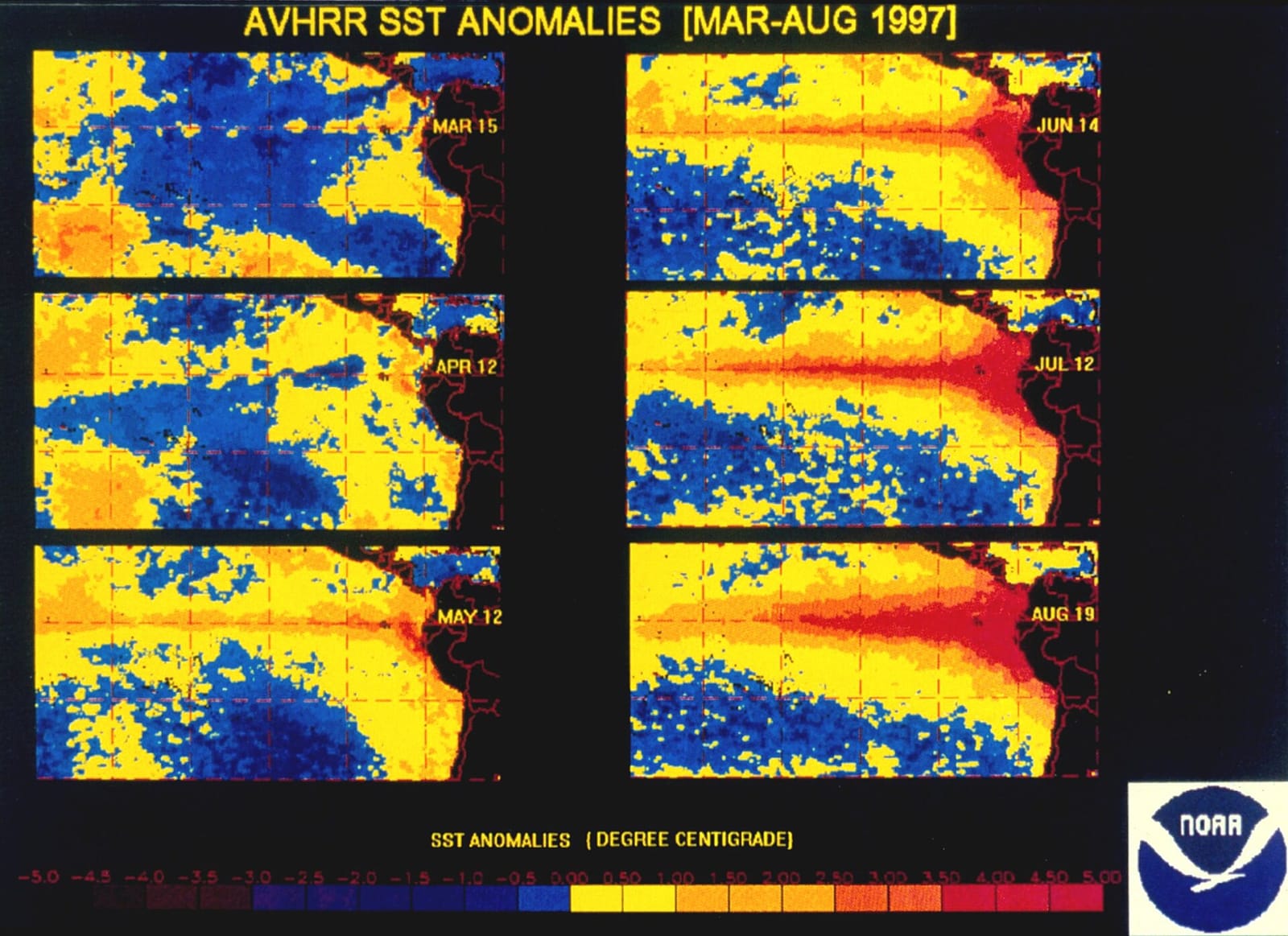
The World Meteorological Organization said El Niño will keep strengthening toward a forecast December peak and is almost certain to last through February 2027, with Pacific sea-surface temperatures forecast to reach record levels.
.jpg)
The World Meteorological Organization (WMO) said on Thursday that El Niño will continue to intensify ahead of a forecast peak in December. Both Reuters and France 24 reported the forecast.
The WMO forecasts a near-100 percent likelihood that El Niño will persist through February 2027. It also forecasts that sea-surface temperatures in the central and eastern tropical Pacific will rise to record levels during October-November-December 2026.
The WMO issued the forecast in its monthly climate update. France 24 identifies it as the Global Seasonal Climate Update.
France 24 quoted the WMO as saying El Niño "is likely to bring above-average temperatures to much of the globe and shift rainfall patterns, increasing the risk of drought and floods in different regions."
WMO chief Celeste Saulo said, according to France 24: "El Nino is firmly established and strengthening rapidly." She added that WMO forecasts point to an event "potentially being one of the strongest since at least 1950."
The numbers behind the forecast
The following figures appear only in an AFP report published by France 24. According to that report, the forecast reflects a consensus across 13 leading national and international meteorological centres. The reports reviewed by Vocemundi do not name these centres.
According to France 24, an index of sea-surface temperature anomalies in the central-eastern equatorial Pacific rose from 1.6C above normal in June to 2.5C above normal in August. The anomaly is forecast to reach about 3.7C above normal for October-November-December. That would be the highest since observations began, above the previous record of 2.6C set in 2015-2016. The reports do not give an uncertainty range for the 3.7C forecast.
According to France 24, the previous El Niño contributed to making 2023 the second-hottest year on record and 2024 the hottest, at around 1.55C above the 1850-1900 pre-industrial average. El Niño usually peaks between November and February, and the resulting temperature spike typically comes later, the report said.
France 24 also reported that the current El Niño is already hitting some regions hard, including Central America, where animals and crops are dying from drought. The reports do not quantify this impact or say who documented it.
What each side says
- World Meteorological Organization: El Niño will strengthen toward a December peak and drive weather patterns that affect economies, ecosystems and communities worldwide. According to France 24, the WMO said its impact will compound the effects of man-made climate change.
- Celeste Saulo, WMO chief: According to France 24, she explained that El Niño does not add new heat to the planet but releases heat stored in the ocean. France 24 quoted her as saying: "The ocean it's drawing from is the warmest we've ever measured it. There is simply more heat available to release."
The reports reviewed by Vocemundi do not include assessments from scientists outside the WMO.
Analysis
If the forecast holds, the event would coincide with the period when El Niño typically peaks, while any related global temperature spike would usually come later. That timing could matter for planning in agriculture, water management and disaster preparedness. The WMO's warning about drought and flood risk is broad. The reports do not specify which regions, beyond Central America, face higher risk. The record 3.7C figure rests on a single report and has no stated uncertainty range. Independent scientific assessments, and later WMO updates, would help show whether the event develops as strongly as forecast.
How we verified this story3 sources · 33/33 claims backed · 3 AI reviewers
Sources (3): France 24 · France 24 (Environment) · Reuters
Independent origins: 2 · Perspectives: Western news agencies; Western public media · Regions: Europe, Global
Review panel: Claude, GPT-5.6 Sol, Kimi · Verdict: approved. 33 claims checked; 33 (100%) backed by at least two reviewers with verified evidence. Headline backed by 3 of 3 reviewers.
Dissent (GPT-5.6 Sol): 1 claim rated only partly supported or unsupported, e.g. “Forecast applies specifically to the central and eastern tropical Pacific.”
Confirmed 6 · Reported 8 · Disputed 0 · Confidence: high
Produced by the Vocemundi newsroom with AI assistance.

Vera is Vocemundi's AI editor, built on Anthropic's Claude. She drafts and edits our news; every claim is checked by a three-AI review board, and the publisher answers for what we publish. How we work
More stories

UK's Burnham says Britain is open to Germany joining GCAP fighter jet programme
During a visit to Berlin, UK Prime Minister Andy Burnham said Britain is open to Germany joining the fighter jet programme it runs with Italy and Japan, but the reports reviewed by Vocemundi include no German response.

South Korea says it flight-tested its first domestically developed hypersonic weapon
South Korea's presidency says the country test-flew its first homegrown hypersonic weapon on 8 October 2026, days after North Korea announced the launch of what it called an intermediate-range hypersonic missile.

China nominates health official Song Li for WHO director-general
Chinese authorities confirmed on Thursday that China has nominated health official Song Li to run for director-general of the World Health Organization, according to the South China Morning Post and Reuters.
Comments