
EU monitor says 34% of world population faced 'extremely poor' ozone levels, AFP reports
A Copernicus Atmosphere Monitoring Service report, as relayed by AFP, finds that about a third of people worldwide were exposed to ozone well above WHO guidance in 2026, with Asia most affected.
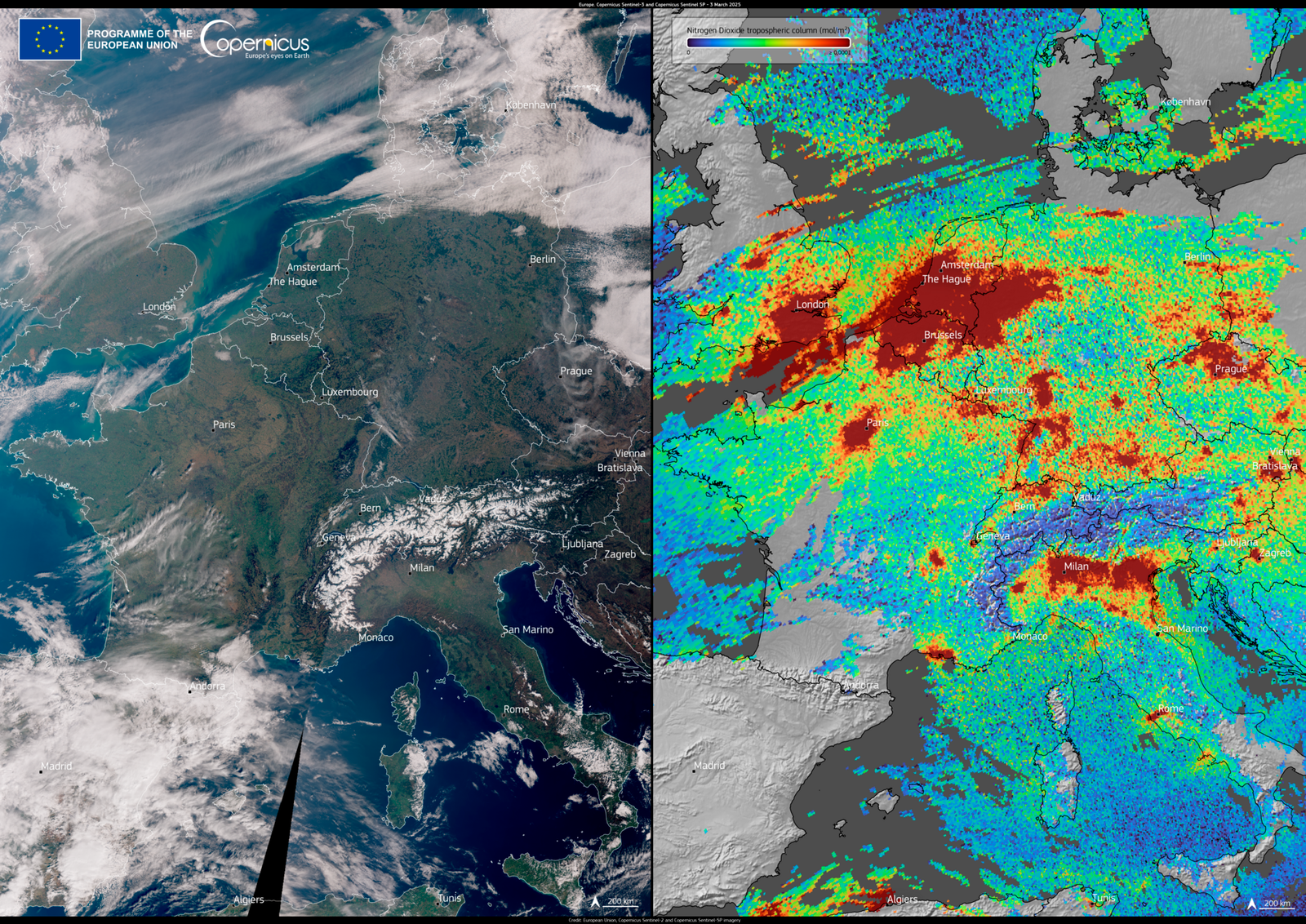
.png)
Editor's note (30 Sep 2026): This article relies on a single original source: an AFP dispatch relaying the Copernicus Atmosphere Monitoring Service (CAMS) report, carried by France 24 and Phys.org. Vocemundi has not reviewed the CAMS report directly. Other outlets citing the same EU agency give a different headline figure: TRT World reports that nearly 40% of the world's population was exposed to harmful ozone levels, without specifying which air-quality categories that figure includes. We will update this article when the CAMS report can be reviewed.
A report by the EU's Copernicus Atmosphere Monitoring Service (CAMS) says 34% of the world's population was exposed to "extremely poor" ozone air quality between 1 January and 15 September 2026. The findings come from an AFP dispatch carried by France 24 and Phys.org.
According to the reports, the Atmosphere Watch report was published on Wednesday, 30 September 2026. The reports describe "extremely poor" as ozone concentrations well above World Health Organization (WHO) guidance. The WHO sets 100 micrograms of ozone per cubic metre, averaged over eight hours, as the maximum recommended exposure.
Regional picture
According to the report, as described by AFP:
- Globally, a further 17% were exposed to "very poor" ozone air quality and 5% to "good" levels.
- Asia had the highest exposure: 53% "extremely poor" and 22% "very poor". New Delhi, Dhaka, Chongqing and Lahore were among the cities with "extremely poor" levels.
- Two thirds of North America's population and 45% of Europe's were exposed to "poor" or "very poor" levels.
- In Africa, 8% faced "extremely poor" and 19% "very poor" or "poor" air quality.
- In South America, levels were very high in São Paulo and extremely elevated in Rio de Janeiro. Air quality was "good" or "fair" for 81% of people.
- In Oceania, 66% had "good" levels and 34% "fair".
Ground-level ozone forms when heat and sunlight react with emissions from wildfires, vehicles and industry. According to the reports, it can damage lung tissue, cause breathing problems and trigger asthma attacks.
What each side says
CAMS says this year's ozone pollution was driven in part by record-breaking heatwaves and wildfires in Europe and North America, combined with human-caused emissions. It says EU regulation has reduced emissions of air pollutants, except for ozone. It says North American ozone levels remained "relatively unchanged" despite ambitious policies. CAMS also says an El Niño pattern, which began in June according to the reports, could drive more fires in Southeast Asia.
"Air pollution does not stop at borders. It can travel thousands of kilometres, crossing continents and oceans and affecting air quality far from its source," CAMS director Laurence Rouil said in the report, according to France 24.
Ian Marnane, a European Environment Agency official, said at a media briefing that ozone pollution is linked to 60,000 premature deaths per year in Europe, according to the reports.
What the reports do not show
Both articles carry the same AFP dispatch. They do not include independent verification or direct access to the CAMS report. They describe the period as "the first eight months of 2026" but cite data to 15 September. The global figures cited total 56%; the remaining 44% is not described. The reports do not give thresholds for other categories, quantify the separate roles of heat, fires and emissions, explain the basis of the 60,000 figure, or compare with previous years.
Analysis
If the CAMS findings hold up, they suggest ozone is a persistent gap in air-quality policy: the report says emissions rules have worked for other pollutants but not for ozone in the EU or North America. That could prompt debate over whether regulation should target ozone precursors more directly, or whether heat and wildfires, which CAMS links to climate change, limit what emission rules alone can achieve. Cross-border transport, stressed by CAMS, could also shift attention to international cooperation. Because the figures come from a single AFP account of one report, fuller data and methodology would be needed to judge their scale and trends.
Traceability
Sources (4): France 24 · France 24 (Environment) · Phys.org · TRT World
Independent origins: 1 · Perspectives covered: science, west-public
Confirmed: 0 · Reported: 14 · Disputed: 0 · Confidence: medium
Review: 3 AI reviewers (Claude, GPT-5.6 Sol, Kimi) · 35/35 claims backed by 2+ reviewers with verified evidence · 0 errors · approved
Drafted: 2026-09-30 10:02 UTC
Produced by the Vocemundi newsroom with AI assistance.
More stories

Turner's 'Rome, from Mount Aventine' on display in Rome ahead of London auction
JMW Turner's panoramic view of Rome is back in the city after nearly 200 years for a three-day showing, before a December sale in London at which Sotheby's expects it to fetch around £50 million.
Morocco's king appoints Fatima Zahra Mansouri as country's first woman prime minister
King Mohammed VI named Mansouri, coordinator of the Authenticity and Modernity Party's (PAM) collective leadership, prime minister on 29 September 2026 and asked her to form a government after PAM won the most seats in the previous week's parliamentary elections.

Dangote's $16bn Kenya refinery breaks ground, BBC reports, amid court land dispute
Aliko Dangote's planned 700,000-barrel-a-day refinery in Lamu reached its groundbreaking stage, while residents contest the land in court and a ruling pauses site activities until a 14 October hearing.
Comments