
A surveillance firm flags suspicious oil orders on Trade.xyz; a day later, the owner of the New York Stock Exchange invests in it
According to Bloomberg and Solidus Labs, two accounts placed more than $170 million in suspicious orders on oil contracts. The next day, ICE and Stan Druckenmiller bought in. What is proven, what is not, and what it has to do with your fuel.

Investigation · Follow the money
Published 29 October 2026 · Updated 29 October 2026 · See timeline
On 28 October, according to Bloomberg, a market surveillance firm flagged more than $170 million in suspicious orders on oil contracts issued by Trade.xyz, according to several outlets citing that analysis. On 29 October, the owner of the New York Stock Exchange and one of Wall Street's best-known investors announced they are putting money into that same company. Neither event proves anything about the other. But together they say a lot about where the money is going, and about who watches the price of oil when the market never closes.
Key points
- The alert. According to Bloomberg and the firm Solidus Labs, two accounts placed more than $170 million in orders with characteristics of spoofing (orders that are placed and canceled before they are executed, in order to move the price) on crude oil contracts on Hyperliquid, between 8 and 10 March 2026. Solidus did not confirm intent. It is not known who operated the accounts.
- The money. The following day, ICE, owner of the New York Stock Exchange, announced a minority investment in Trade.xyz to bring those contracts to the United States, subject to approval by the CFTC, the futures regulator. Investor Stan Druckenmiller said on X that he is also an investor in Trade.xyz.
- Why it matters to you. These contracts track the price of oil 24 hours a day, including when traditional exchanges are closed. What happens in them can influence expectations about crude, and crude ends up in what you pay for fuel.
What happened
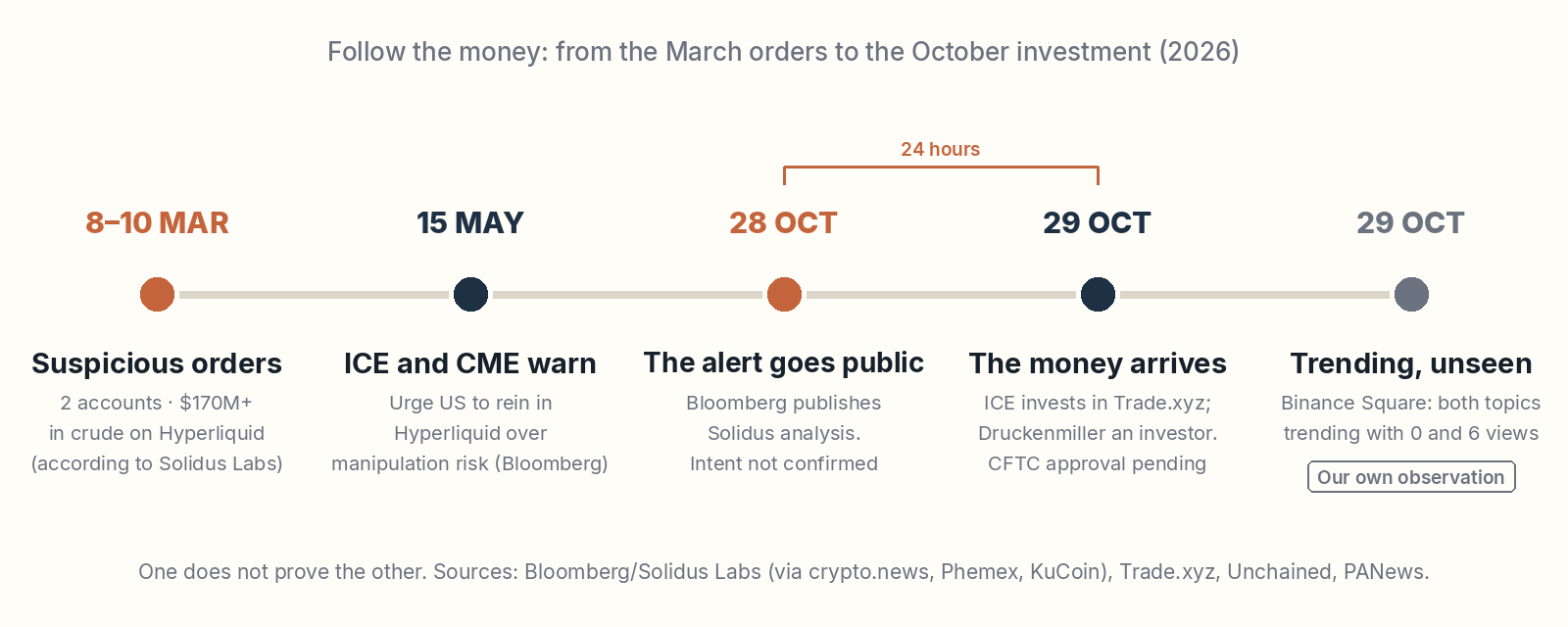
The orders. According to the Solidus Labs analysis published by Bloomberg on 28 October, between 8 and 10 March 2026, amid oil price volatility, two accounts repeatedly placed large orders on one side of the book and canceled them while trades were being executed on the opposite side. Most of it occurred in the Brent perpetual contract; according to crypto.news, there was also activity in WTI and natural gas. According to Phemex and KuCoin, the contracts are issued by Trade.xyz, one of the market operators on Hyperliquid.
The figures, according to Solidus Labs.
| Data point | Value | Source |
|---|---|---|
| Suspicious orders | More than $170 million, over 3 days | Solidus Labs, via Bloomberg (crypto.news, Phemex, KuCoin, Bloomingbit, TechFlow) |
| Accounts | 2 | Solidus Labs, via Bloomberg |
| Canceled versus executed | Roughly 30 to 1 by value | Solidus Labs, via crypto.news and TechFlow |
| Example from 9 March | About $17 million in canceled sell orders, versus about $425,000 in executed buys | Solidus Labs, via crypto.news, Phemex and KuCoin |
| Estimated profit | About $119,000 over three days | Solidus Labs, via Bloomberg |
The responses. Hyperliquid Labs said that all orders, cancellations and trades are publicly recorded on the blockchain and available to market participants and regulators. Trade.xyz, according to Phemex and KuCoin, pointed to its order limits and its continuous monitoring.
The legal standard. In the United States, spoofing is prohibited under the Dodd-Frank Act, and the CFTC's 2013 guidance requires proof of intent to cancel the order before it is executed; a good-faith cancellation does not qualify. A suspicious pattern in the data is not enough on its own.
Who's who
| Player | What it is | Its role here |
|---|---|---|
| Hyperliquid | Decentralized crypto derivatives exchange with its own blockchain. Its development company, Hyperliquid Labs, is based in Singapore, according to Bloomberg. Closed to U.S. users. | Where the orders took place. |
| Trade.xyz | Operates markets on Hyperliquid: stocks, indexes and commodities in perpetual contracts. Says it has surpassed $650 billion in volume in just over a year (company figure). | Issuer of the crude oil contracts, according to Phemex and KuCoin. Recipient of ICE's investment. |
| Solidus Labs | Market surveillance company. | Author of the analysis of the orders. Did not confirm intent. |
| ICE | Intercontinental Exchange, owner of the New York Stock Exchange and of major energy futures markets, including Brent. | Minority investment in Trade.xyz and operator of the planned U.S. market. |
| Stan Druckenmiller | American billionaire investor. | Announced on X that he is an investor in Trade.xyz. |
| CFTC | U.S. Commodity Futures Trading Commission. | Must approve the ICE and Trade.xyz market. It is also the authority that prosecutes spoofing. |
| The 2 accounts | Unknown operator. | No one has been formally accused. |
What is proven and what is not
- Solidus Labs provided Bloomberg with an analysis of suspicious orders on Hyperliquid crude oil contracts (28 October).
- Trade.xyz and ICE announced the investment and the plan for a U.S. market, subject to the CFTC (29 October). The amount was not disclosed.
- Druckenmiller posted on X that he is an investor in Trade.xyz.
- In May, according to Bloomberg, ICE and CME asked U.S. authorities to place limits on Hyperliquid over the risk of oil price manipulation.
- That anyone manipulated the price: Solidus speaks of characteristics of spoofing, not of proven intent.
- Who is behind the two accounts.
- That there is any link between the 28 October alert and the 29 October investment: there is no evidence that one depends on the other.
- How much those orders moved the actual price of crude, if they moved it at all.
Follow the money
From complaint to investment. On 15 May, according to Bloomberg, ICE and CME Group told the CFTC and Congress that Hyperliquid could distort global oil prices and facilitate manipulation because of its anonymous, round-the-clock trading. That same month, according to Unchained, ICE chairman Jeffrey Sprecher said he had met with Hyperliquid several times and described it as "bigger than Nasdaq." Five months later, ICE is investing in one of the main market operators on that platform. Sprecher said he sees these contracts as "a complement" to his futures markets, "not a replacement."
Where the money moved on 29 October. HYPE, Hyperliquid's cryptocurrency, rose about 14% in 24 hours after the announcement, according to CoinGecko ($91 at 14:00 UTC). Bitcoin, by contrast, spent much of the day hovering around $80,000, with stretches below that level (Coinbase).
What the newcomers gain. ICE will be the exclusive operator of the regulated market in the United States and, according to bitcoin.com, will keep that retail business separate from its institutional clearing. According to the same outlet, ICE said the investment will not materially affect its 2026 results. Trade.xyz highlighted, according to Unchained, ICE’s more than 25 years of operating regulated markets. The deal also opens a path to U.S. customers, who are currently excluded from Hyperliquid.
The trending topics nobody was looking at
On 29 October, Binance Square, the social network of the Binance platform, listed both stories among its trending topics: the Solidus alert with 0 views and 3 people discussing it, and the Druckenmiller investment with 6 views and 15 people discussing it. We observed this directly on the platform.
What it means for you
| Channel | Effect | Why |
|---|---|---|
| Fuel | Indirect | The price of oil is set on large futures exchanges such as those of ICE and CME. But crypto contracts keep trading when those exchanges close, and according to the Hyperliquid Policy Center, the platform's own think tank, in about 75% of the weekend closes analyzed the perpetual ended closer to the Sunday reopening price than to the Friday close. If they can be distorted, they can influence the expectations with which the market opens on Monday. There is no evidence that what happened in March changed the price at the pump. |
| Small investors | High | Perpetuals are traded with leverage. If someone places and cancels huge orders to move the price, traders with thin margins can be liquidated by a move that does not reflect real supply or demand. |
| Regulation | Pending | Nothing has been approved. If the CFTC authorizes the ICE and Trade.xyz market, there would be U.S.-style identity verification and surveillance, but only for that market: Trade.xyz's contracts on Hyperliquid will keep trading in parallel. |
| Your country | Varies | Hyperliquid does not require users to identify themselves and is available outside the United States, including in Latin America and Europe. User protection depends on each local regulator, and not all of them have rules for this type of product. |
In practice. If you trade crypto perpetuals, especially commodity ones, keep in mind that a "full" order book may not be real, use little leverage, and do not rely on a single market to know what something is worth.
Open questions
- Who controls the two accounts, and has any authority requested the data?
- Will the CFTC review the March case before deciding on the ICE and Trade.xyz market?
- How much did ICE and Druckenmiller invest, and for what stake?
- What order limits and surveillance does Trade.xyz apply today, and since when?
- Who boosted the Binance Square trending topics on 29 October, if anyone did?
Our forecasts
What to watch
- Whether the CFTC opens a consultation or receives the formal application for the ICE and Trade.xyz market.
- Whether Bloomberg or Solidus Labs publish more details, or whether the owner of the accounts comes to light.
- The response from CME Group, the other major oil futures market, which in May also called for limits on Hyperliquid.
- The price of HYPE and the volume of Trade.xyz's crude oil contracts in the coming weeks.
Timeline
- Two accounts place and cancel large orders on crude oil contracts on Hyperliquid, according to Solidus Labs.
- According to Bloomberg, ICE and CME ask the CFTC and Congress to place limits on Hyperliquid over the risk of oil price manipulation.
- The Hyperliquid Policy Center and Trade.xyz ask the CFTC for a regulated framework for energy perpetuals (WTI, Brent and Henry Hub gas), according to crypto.news.
- Bloomberg publishes the Solidus Labs analysis: more than $170 million in suspicious orders.
- ICE announces its investment in Trade.xyz and Druckenmiller says he is an investor. Both stories appear as trending topics on Binance Square with almost zero views. Publication of this investigation with three open forecasts.
Vocemundi did not have access to Solidus Labs' original data; intent to manipulate has not been proven.
One forecast resolved so far, and it was correct (European summit, analysis of 14 October). The counter is updated as each forecast comes due.
Sources and method12 sources · facts separated from analysis
Solidus Labs alert (origin: Bloomberg, 28 October): crypto.news, Phemex, KuCoin News, Bloomingbit and TechFlow. We were unable to read the original Bloomberg article (paywalled); the figures match across these outlets, which cite it.
ICE and Druckenmiller investment (29 October): Unchained, bitcoin.com, PANews and Trade.xyz's announcement on X.
Background: Bloomberg (15 May 2026, "CME, ICE Push US to Curb Crypto's Oil Trading Upstart"). Prices: CoinGecko and Coinbase (29 October, 14:00 UTC). Binance Square: direct observation by Vocemundi on 29 October.
Method: allegations are always attributed; anything marked "Our reading" is our own analysis. Each forecast has a date and an objective verification rule; the probabilities are our estimate, not a certainty.
More stories
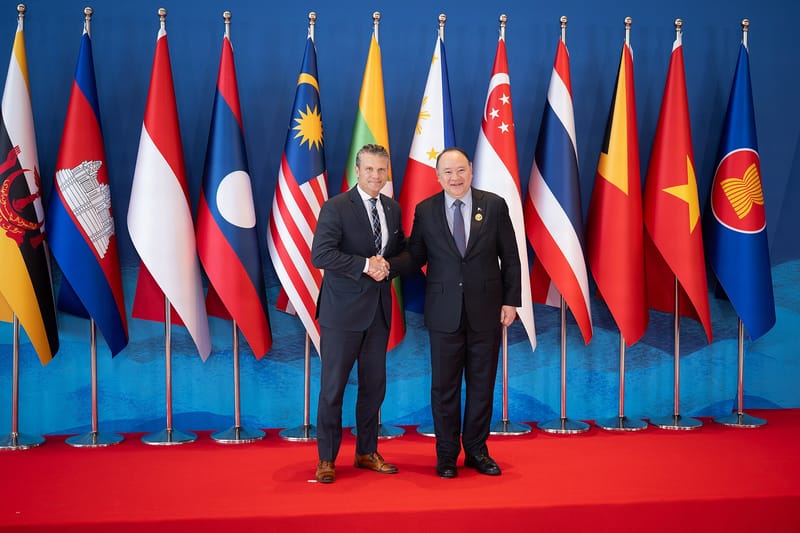
China accuses Philippines of obstructing its participation in ASEAN defence ministers' meeting
China's defence ministry said on Thursday that the Philippines had created obstacles to China's participation in an ASEAN defence ministers' meeting being held in the Philippines, amid strained relations between the two countries.

Hong Kong leader John Lee apologises for Tai Po fire that killed 168 people
Hong Kong's Chief Executive apologised for the November 2025 fire after an independent committee reported regulatory failures, and France 24 reports that the housing secretary has resigned.

South Africa names Durban as main candidate city for 2036 or 2040 Olympic bid
South Africa's Olympic committee chose Durban over Johannesburg and Cape Town to lead its bid for the 2036 or 2040 Summer Games, but officials say they cannot yet estimate the cost.
Comments