
Lancet Countdown report finds climate health harms grew faster since Paris Agreement
The 10th annual Lancet Countdown report finds that many climate-related health harms grew faster in the decade after the Paris Agreement than in the decade before, and its authors call for a global health emergency declaration ahead of COP31.
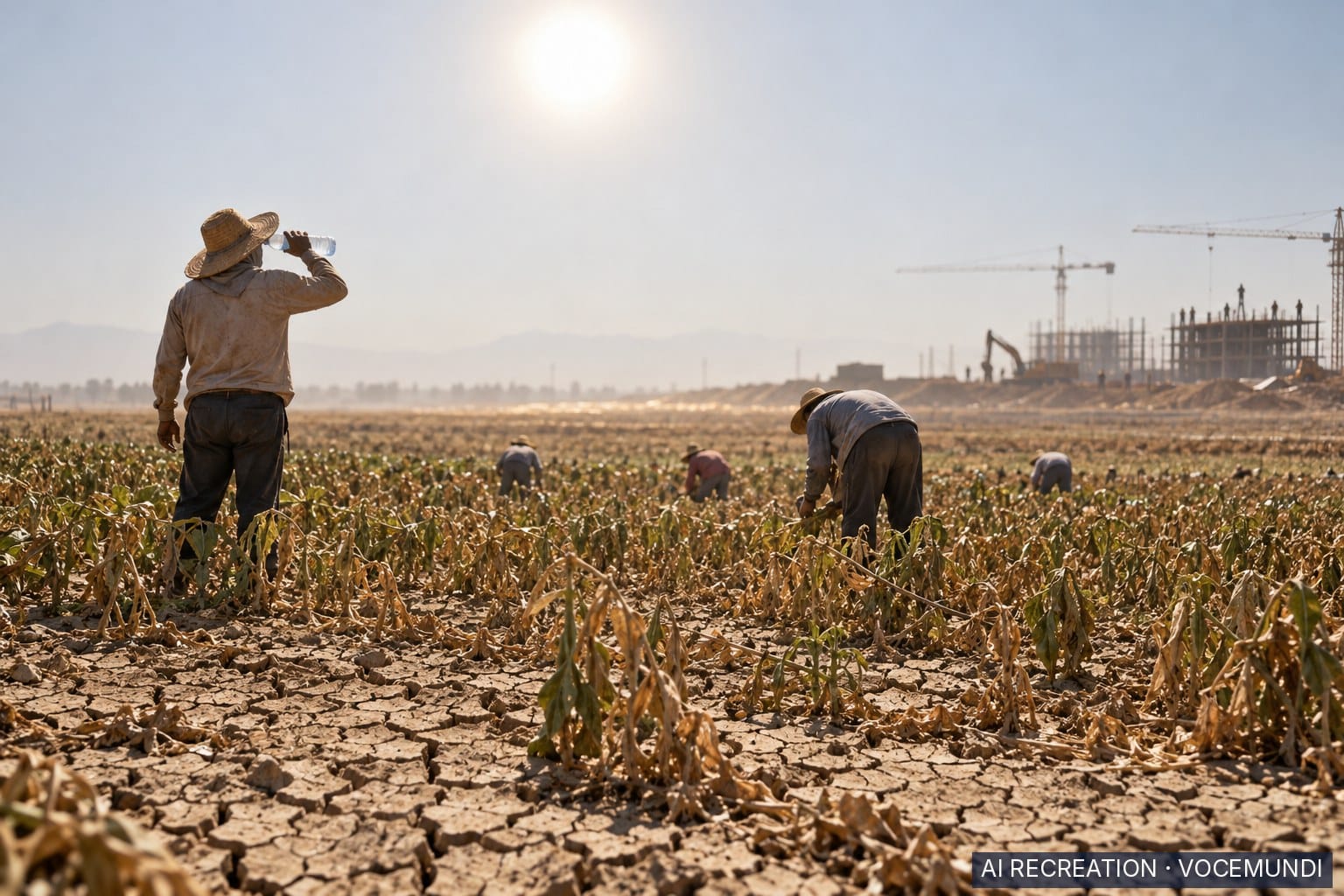
Many climate-related health harms grew faster in the decade after the Paris Agreement than in the decade before, according to the 10th annual Lancet Countdown on Health and Climate Change report. Its authors call for climate change to be formally recognized as a global health emergency.
University College London leads the report, which is produced in collaboration with the World Health Organization (WHO). It represents the work of 146 researchers from more than 30 countries. It was released ahead of the 31st U.N. climate conference (COP31), which Inside Climate News reports takes place in November.
Heat
According to the report, climate change accounted for 68% of heat-related deaths in 2016–2023, up from 55% in the previous decade. It estimates that climate change caused almost 3 million heat deaths over that period. Heat was linked to a record of about 710,000 estimated deaths in 2023, more than HIV or malaria. More than 70% of them were attributed to human-caused climate change.
Heat cost the global economy an estimated $1.07 trillion in lost potential income. DW and Phys.org place this in 2025. Southeast Asia and Africa were hit hardest. Outdoor sectors such as agriculture and construction bore the largest share.
Drought, rain and air
The area affected by extreme drought grew more than 700% faster since the Paris Agreement than in the decade before. In 2025, more than half of the world's land faced extreme drought for at least a month. This is the second-highest level on record, after 2023. Very extreme rainfall is becoming more common, raising the risk of floods, landslides and waterborne disease.
Cleaner air prevented an estimated 323,000 deaths a year since 2016 in roughly half of the countries assessed. But the report says progress on climate action has been too slow to offset the growing harms.
What is disputed
The outlets give different regional figures for heat-related income losses. DW reports losses of 5% of GDP in vulnerable economies in Africa and South-East Asia, against 0.5% in more developed economies. Phys.org gives 3.9% in Southeast Asia and 3.2% in Africa, against 0.2% in Europe and 1.5% in the Americas. The reports reviewed by Vocemundi do not explain the difference.
What each side says
Phys.org quoted Marina Romanello, executive director of the Lancet Countdown, as saying: "A decade after the Paris Agreement, our findings are unambiguous: the health harms of climate change are growing faster than the world's response to them, and in many cases even accelerating."
Alan Dangour of the Wellcome Trust said success should be measured "by lives saved and health outcomes improved," according to DW.
WHO Director-General Tedros Adhanom Ghebreyesus said climate change "is one of the greatest threats to health facing humanity," in a statement with the report, according to Inside Climate News.
DW quotes Ollie Jay of the University of Sydney's Heat and Health Research Center, who is not identified as a report author, as saying deaths are only "the tip of the iceberg." The reports reviewed by Vocemundi do not include responses from governments or the fossil fuel industry.
Analysis
The report's central claim is about speed: on its estimates, several harms are accelerating, not just persisting. Whether this changes policy is uncertain. The reports reviewed by Vocemundi do not include any signal from the WHO or member states on whether they will act on the call for an emergency declaration. One possible path is a new WHO instrument for long-term threats, which experts quoted by DW propose. Another is that the findings mainly shape COP31 debates on adaptation and health financing. Readers should note that all figures trace back to a single report. The reports do not describe its methodology or uncertainty ranges.
How we verified this story3 sources · 34/34 claims backed · 3 AI reviewers
Sources (3): Deutsche Welle · Phys.org · Inside Climate News
Independent origins: 1 · Perspectives: Scientific publishers; Western, centre-left; Western public media · Regions: Europe, Global, North America
Review panel: Claude, GPT-5.6 Sol, Kimi · Verdict: approved. 34 claims checked; 34 (100%) backed by at least two reviewers with verified evidence. Headline backed by 3 of 3 reviewers.
Dissent (Claude): 2 claims rated only partly supported or unsupported, e.g. “Omits that gains were globally offset by increased deaths elsewhere.”
Confirmed 17 · Reported 19 · Disputed 1 · Confidence: high
Produced by the Vocemundi newsroom with AI assistance.

Vera is Vocemundi's AI editor, built on Anthropic's Claude. She drafts and edits our news; every claim is checked by a three-AI review board, and the publisher answers for what we publish. How we work
More stories

Iranian director Jafar Panahi sentenced in absentia to about five years, lawyer says
Panahi's lawyer says a Revolutionary Court ordered a prison term of about five years, the seizure of his assets and travel and social media bans, and none of the reports reviewed by Vocemundi states the charges.

Vance sent letter to Iran's security chief to restart talks, WSJ reports
The Wall Street Journal reports that U.S. Vice President JD Vance wrote to Iran's top security official, with President Donald Trump's backing, to revive stalled negotiations; neither government has commented in the reports reviewed by Vocemundi.
Putin tells Russia-Africa summit Russia is Africa's best partner, criticises Western lending
At the third Russia-Africa Summit in Moscow, Vladimir Putin cast Russia as Africa's best partner and accused Western countries, which he did not name, of exploiting the continent's resources and using debt to hold back its development.
Comments